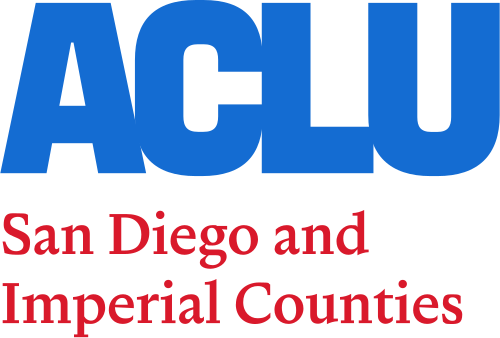

In the first week of his second presidency, Donald Trump immediately began dismantling due process to help further his aggressive and cruel immigration and mass deportation agenda.
Through a rapid series of executive orders and other actions, the Trump administration expanded immigration detention, accelerated deportations and dismantled critical safeguards. Programs that help immigrants understand their rights were cut back or eliminated. People seeking asylum were pushed out of the country altogether.
These actions were designed to erode the basic conditions that make due process possible.
Due process is a constitutional protection guaranteed to everyone, regardless of citizenship. It upholds the idea that everyone deserves fairness, dignity and equal protection under the law.
At its core, due process ensures that when the government seeks to deprive someone of their rights, liberty or property, that person has a meaningful opportunity to understand and contest the case being made against them.
The federal administration’s actions attempt to significantly raise the barriers and even eliminate that opportunity entirely by making it harder for people to understand their rights, gather evidence, access legal support and navigate an already complicated legal system.
When due process is weakened, government power expands. And this expansion leaves all of us vulnerable to uncontestable government actions.
ACLU FIREWALL FOR FREEDOM
In response to the threats posed by the second Trump administration, the ACLU advanced a broader strategy: the Firewall for Freedom.
This strategy is based on a simple insight: federal power alone rarely enables rights violations. Lessons from Trump’s first term show how coordinated state and local action can blunt extreme policies. This strategy recognizes that federal overreach usually needs local cooperation to succeed.
The Firewall for Freedom is a broad approach to protecting our civil rights and liberties. At its core, it asks whether local governments are reinforcing those rights through their policies or enabling their erosion through unnecessary collaboration.
SAN DIEGO OPERATIONALIZING THE FIREWALL OF FREEDOM
San Diego is a proud binational region, home to the busiest land border crossing in the world. Immigrants and children of immigrants represent about one-third of its population.
Unlike the ICE surges that drew national attention in Los Angeles, Minnesota and Chicago, operations in San Diego have been less visible. However, between May and October of last year, there was a 1,500 percent increase in arrests for civil violations of immigration law as compared to the same period in 2024.
In response, the ACLU of San Diego & Imperial Counties, along with many other local organizations, joined forces with community members to advocate for stronger policies to protect our region and our rights.
And local governments have been listening. Cities across San Diego County have begun to operationalize their own Firewall of Freedom. While each jurisdiction takes a different form, they all reflect the same underlying approach — expanding protections and drawing clearer boundaries around how local resources are used in federal enforcement efforts.
The policies passed in San Diego are about protecting communities as well as ensuring that local governments uphold civil rights, build community trust and use their authority responsibly.
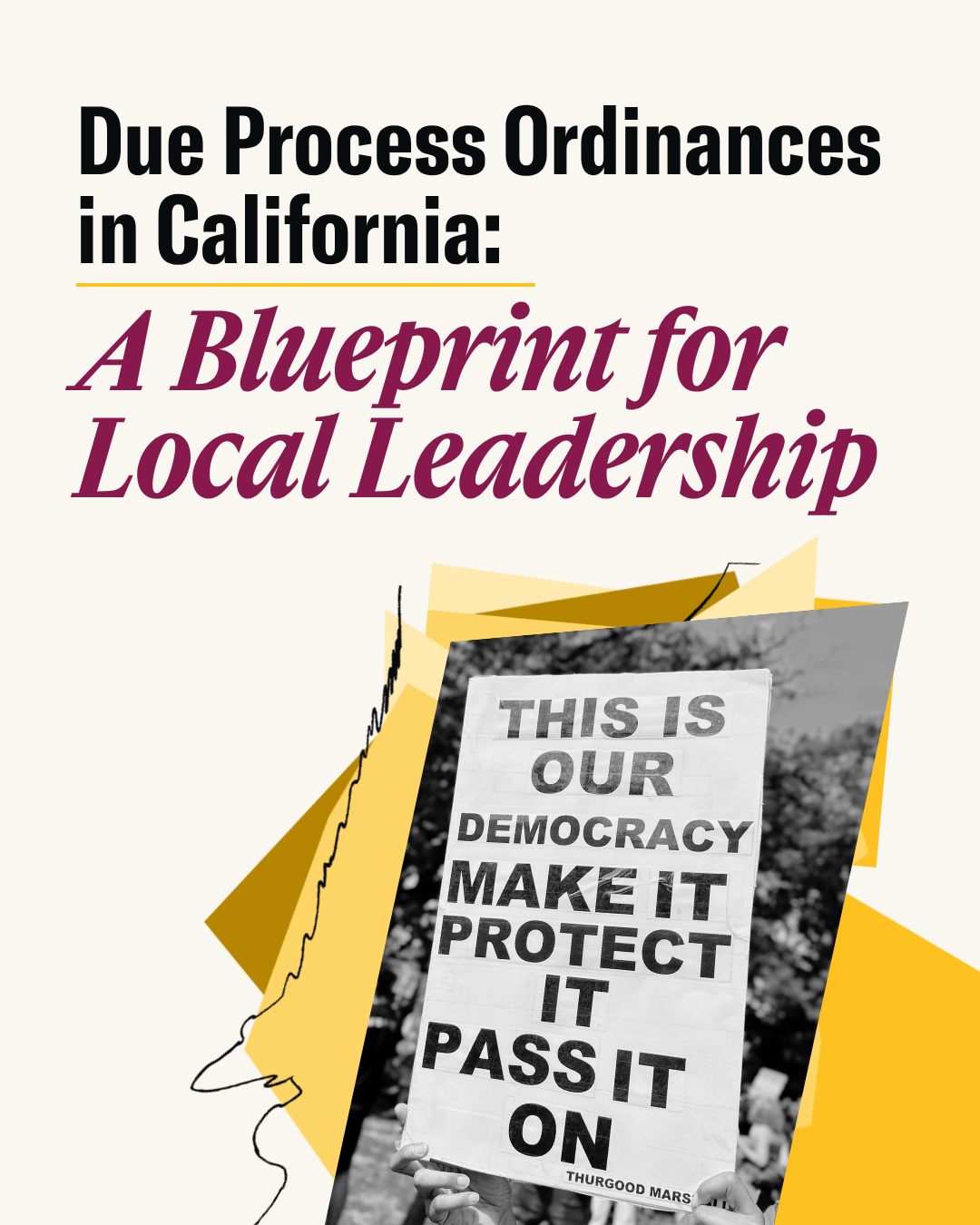
Check out this factsheet for due process policy guidance
ORDINANCES PASSED IN SAN DIEGO
City of San Diego – Due Process and Safety Ordinance
Passed: 9–0
October 29, 2025
The City of San Diego adopted a landmark ordinance that establishes safeguards against government overreach and limits collaboration with federal law enforcement when targeting protected personal characteristics like immigration status, political or religious beliefs, race, ethnicity, sexuality or gender identity.
City of Vista – Community Safety and Due Process Resolution
Passed: 3–2
November 18, 2025
Vista’s resolution focuses on protecting people’s rights under state and federal law. The city resolved to actively share Know Your Rights educational materials, prohibit federal immigration enforcement activities in non-public city spaces without a warrant and restrict the sharing of personal characteristic data unless required by law.
City of Chula Vista – Good Neighbor Resolution
Passed: 4–0
November 18, 2025
Chula Vista’s resolution expanded Know Your Rights outreach and established guidelines for responding to federal immigration enforcement requests. Additionally, as part of the resolution, the city will explore funding partnerships with local nonprofits for crisis relief, case management and legal aid services.
County of San Diego – CLEAR Ordinance
Passed: 3–1
January 28, 2026
San Diego County adopted the Civil Liberties Enforcement and Accountability Rules (CLEAR), creating structural limits on federal access to county facilities, requiring safeguards for protected personal data and restricting participation in joint task forces that target protected personal characteristics.
EXPANDING THE FIREWALL FOR FREEDOM
President Trump’s attacks on immigrant communities and constitutional rights have been relentless, cruel and dehumanizing.
This administration is also targeting environmental regulations, reproductive rights, free speech and our public education system. It is restricting access to food, housing and healthcare, and gutting protections for students, people with disabilities, employees and LGBTQIA+ communities. It is even trying to dismantle the very foundation of our democracy.
As this administration’s abuse of power multiplies, cities and states are well-positioned to advance the fight for freedom. Regardless of which party controls a state’s government, municipal advocacy presents real opportunities to build Firewalls of Freedom across the nation.
Now is the moment for policymakers and community members and leaders to act. Local officials can begin by reviewing existing city or county policies with an eye toward strengthening protections important to your communities.
Convening public discussions about constitutional rights and forming working groups to identify gaps in local policies are other immediate steps cities and states can take to protect their residents from federal attacks and overreach.
By taking practical actions like assessing local ordinances, initiating community conversations and collaborating with advocacy organizations, leaders at every level can help ensure that everyone's rights are protected — starting in their own backyard.
Related Issues
Related Content
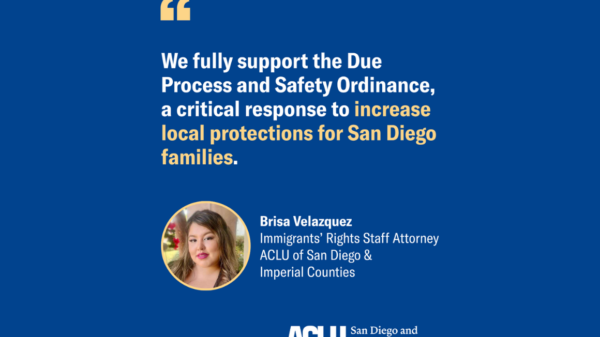
ACLU-SDIC Testimony – San Diego City Council Considers Due Process & Safety Ordinance
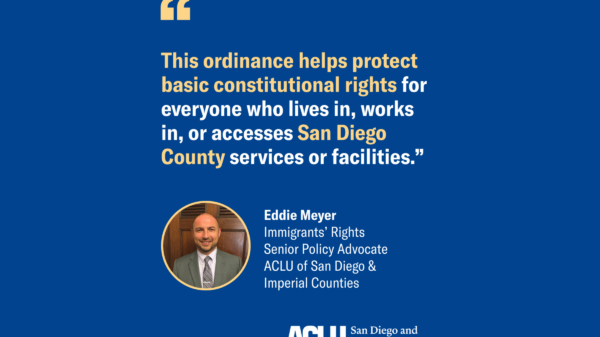
ACLU-SDIC Testimony – San Diego County Board of Supervisors Considers CLEAR Ordinance
Stay Informed
Sign up to be the first to hear about how to take action.
By completing this form, I agree to receive occasional emails per the terms of the ACLU’s privacy statement.
By completing this form, I agree to receive occasional emails per the terms of the ACLU’s privacy statement.