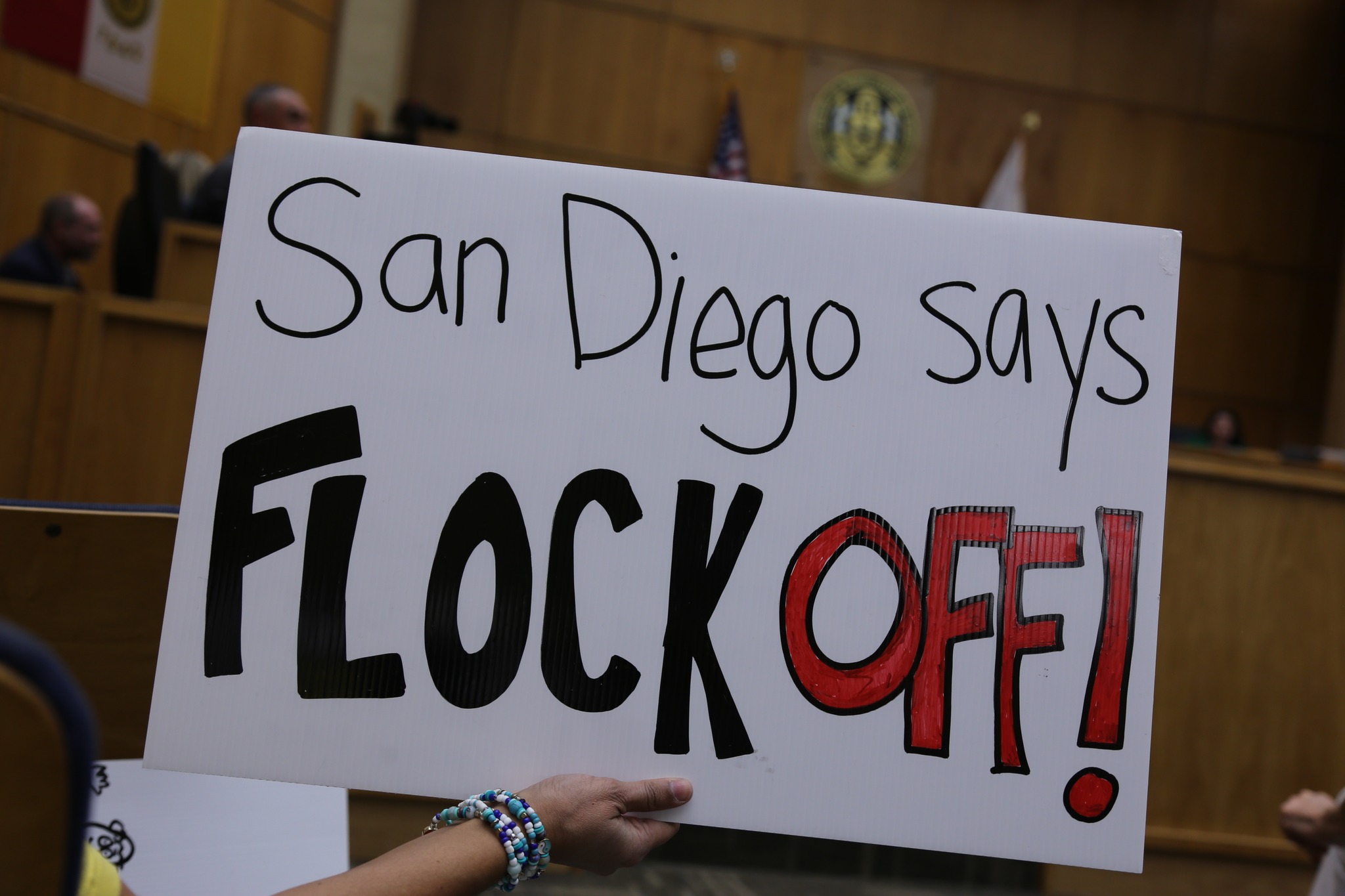
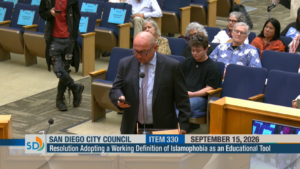
Blue background with white and yellow quote text reads "San Diegans don't need more watchful eyes, they need a helping hand. We urge the San Diego City Council to end the contract with Flock Safety." Quote by Blair Overstreet Central San Diego Organizer ACLU of San Diego and Imperial Counties.

ACLU-SDIC Testimony – San Diego City Council Considers Whether to Continue Surveillance Use Policies

The following testimony outlines the ACLU-SDIC's opposition to the San Diego City Council continuing the city's contract with Flock Safety. This testimony was delivered before the San Diego City Council by ACLU-SDIC Central San Diego Organizer Blair Overstreet on December 9, 2025.

By Blair Overstreet

Latest Press Release


The ACLU of San Diego & Imperial Counties Launches Local Civic Engagement Campaigns

Nationwide, our communities are experiencing a coordinated attack on our civil rights designed to make us feel overwhelmed and powerless.
Placeholder image

More from the Press


Placeholder image

Stay informed on civil rights issues. Discover our latest actions and updates in the Press Release section.

Quote in white text from Nalini Gupta, ACLU-SDIC managing policy director

ACLU-SDIC Testimony – Vista City Council Considers the Community Safety and Due Process Resolution

The following testimony outlines the ACLU-SDIC's support for the Vista Community Safety and Due Process Resolution. This testimony was delivered before the Vista City Council by ACLU-SDIC Managing Policy Director Nalini Gupta on November 18, 2025.
Quote graphic of Brisa Velazquez, ACLU-SDIC immigrants' rights staff attorney

ACLU-SDIC Testimony – San Diego County Board of Supervisors Considers Drafting CLEAR Ordinance

The following testimony outlines the ACLU-SDIC's support for drafting the Civil Liberties Enforcement and Accountability Rules (CLEAR) Ordinance. This testimony was delivered before the San Diego County Board of Supervisors by ACLU-SDIC Staff Attorney Brisa Velazquez October 21, 2025.

By Brisa Velazquez

Brisa Velazquez quote

ACLU-SDIC Testimony – San Diego City Council Considers Due Process & Safety Ordinance

The following testimony outlines the ACLU-SDIC's support for the Due Process & Safety Ordinance proposed. This testimony was delivered before the San Diego City Council by ACLU-SDIC Immigrants' Rights Staff Attorney Brisa Velazquez October 20, 2025.

By Brisa Velazquez

What's the Difference Between the ACLU and the ACLU Foundation?

Placeholder image

Available for Your Club, Workshop, Seminar, Debate & More!

Contact us to request a speaker for your event or program from our Speaker's Bureau of lawyers and other civil liberties advocates who are prepared to discuss a variety of civil liberties issues and the work of the ACLU.

Please help us figure out the best possible speaker for your event by indicating:

Placeholder image

2012 Fellowship Opportunity

The ACLU Foundation of San Diego & Imperial Counties (ACLU-SDIC) seeks applicants to sponsor for public interest fellowships beginning in the Fall of 2012. America's foremost advocate of individual rights, the American Civil Liberties Union is a non-partisan organization founded in 1920. With national headquarters in New York and Washington D.C. and 53 affiliates throughout the country, it is widely regarded as one of the nation's premier public interest law firms.

The ACLU-SDIC promotes and defends civil rights and civil liberties, including freedom of speech, immigrants� rights, equal protection, privacy, and due process, through litigation and public education. Located in beautiful San Diego, the ACLU-SDIC affiliate has sixteen staff members, eighteen board members, more than 8,500 members and an annual budget of $1.2 million.

Fellowship Sponsor Opportunity:
ACLU-SDIC seeks applicants to sponsor for public interest fellowships such as Skadden or Equal Justice Works to begin Fall 2012. ACLU-SDIC is particularly interested in sponsoring a candidate who will work on a project defending and expanding civil rights and civil liberties in one of the following categories: Border Justice/Immigrants� Rights, National Security, Voter Empowerment, or Racial Justice, though proposals in other areas may be considered. Proposed projects should combine litigation and advocacy with community outreach and public education. The proposal should not include direct legal services.

The ACLU staff will work with candidates to finalize their proposals and applications.

Qualifications:
� Must graduate law school in or before summer 2012.
� Admitted to California bar, or sit for July 2012 California bar exam
� Excellent legal research and writing skills.
� Skilled at complex analytical legal work.
� Committed to advancing civil rights and civil liberties.

Salary and Benefits:
To be determined on an individual basis.

Application Procedure:
Individuals interested in receiving ACLU-SDIC sponsorship should send a letter of interest describing a potential project or projects, a resume, an unofficial transcript, the names and telephone numbers of two legal references, and a legal writing sample by email to jmorgan@aclusandiego.org or by mail to:

Placeholder image

ACLU Spring 2010 Newsletter

Click on the link below to view the ACLU's Spring 2010 newsletter.

If you'd like to receive a printed copy, please send us your mailing address. Be sure to tell us in the body of the email what you'd like us to mail to you!

Placeholder image

ACLU 2008-2009 Review

Please click on the link below to download a PDF booklet with the ACLU's major legal, legislative and advocacy accomlishments last year.

Placeholder image

Bill of Rights

Amendment 1
Congress shall make no law respecting an establishment of religion, or prohibiting the free exercise thereof; or abridging the freedom of speech, or of the press, or the right of the people peaceably to assemble, and to petition the Government for a redress of grievances.

Amendment 2
A well regulated Militia, being necessary to the security of a free State, the right of the people to keep and bear Arms, shall not be infringed.

Amendment 3
No Soldier shall, in time of peace be quartered in any house, without the consent of the Owner, nor in time of war, but in a manner to be prescribed by law.

Amendment 4
The right of the people to be secure in their persons, houses, papers, and effects, against unreasonable searches and seizures, shall not be violated, and no Warrants shall issue, but upon probable cause, supported by Oath or affirmation, and particularly describing the place to be searched, and the persons or things to be seized.

Amendment 5
No person shall be held to answer for a capital, or otherwise infamous crime, unless on a presentment or indictment of a Grand Jury, except in cases arising in the land or naval forces, or in the Militia, when in actual service in time of War or public danger; nor shall any person be subject for the same offense to be twice put in jeopardy of life or limb, nor shall be compelled in any criminal case to be a witness against himself, nor be deprived of life, liberty, or property, without due process of law; nor shall private property be taken for public use without just compensation.

Amendment 6
In all criminal prosecutions, the accused shall enjoy the right to a speedy and public trial, by an impartial jury of the State and district wherein the crime shall have been committed; which district shall have been previously ascertained by law, and to be informed of the nature and cause of the accusation; to be confronted with the witnesses against him; to have compulsory process for obtaining witnesses in his favor, and to have the assistance of counsel for his defense.

Amendment 7
In Suits at common law, where the value in controversy shall exceed twenty dollars, the right of trial by jury shall be preserved, and no fact tried by a jury shall be otherwise re-examined in any Court of the United States, than according to the rules of the common law.

Amendment 8
Excessive bail shall not be required, nor excessive fines imposed, nor cruel and unusual punishments inflicted.

Amendment 9
The enumeration in the Constitution of certain rights shall not be construed to deny or disparage others retained by the people.

Amendment 10
The powers not delegated to the United States by the Constitution, nor prohibited by it to the States, are reserved to the States respectively, or to the people.

...and the post-Civil War amendments, from which many of our current due process rights evolve...

Amendment 13
Neither slavery nor involuntary servitude...shall exist within the United States, or any place subject to their jurisdiciton.

Amendment 14
....No State shall make or enforce any law which shall abridge the privileges or immunities of citizens of the United States; nor shall any State deprive any person of life, liberty, or property, without due process of law; nor deny to any person within its jurisdiction the equal protection of the laws....

Amendment 15
The right of citizens of the United States to vote shall not be denied or abridged by the United States or by any State on account of race, color, or previous condition of servitude....

...and the amendment giving women--finally--the right to vote...

Amendment 19
The right of citizens of the United States to vote shall not be denied or abridged by the United States or by any State on account of sex.

Placeholder image

The ACLU Mandate

The mission of the ACLU is to assure that the Bill of Rights - amendments to the Constitution that guard against unwarranted governmental control - is preserved for each new generation. To understand the ACLU's purpose, it is important to distinguish between the Constitution and the Bill of Rights. The Constitution itself, whose bicentennial we celebrated in 1987, authorizes the government to act. The Bill of Rights limits that authority.

The Bill of Rights lays out the guiding principles of our democratic government: freedom and equality for all. It serves as the ACLU's blueprint for action today just as it has since our inception in 1920.

At our founding, the Constitution and the Bill of Rights were nearly 150 years old, yet people could not freely exercise many of the rights the Constitution guaranteed. People were denied the right to demonstrate publicly. There was no curb against censorship. Women's rights were unprotected. Racial discrimination was open and legal. There was no due process for the accused, and little protection for religious freedom. By winning one precedent-setting case after another, the ACLU has established the vast majority of civil liberties in the land.

First Amendment rights:
These include freedom of speech, association and assembly, freedom of the press, and freedom of religion, including the strict separation between church and state which is the foundation of religious liberty.

Equal protection of the law:
The right to equal treatment regardless of race, sex, religion, national origin, sexual orientation, age, physical disability, or other such classification. These rights apply to the voting booth, the classroom, the workplace and the courts.

Due process of law:
The right to be treated fairly when facing criminal charges or other serious accusations that can result in such penalties as loss of employment, exclusion from school, denial of housing, or cut-off of benefits.

The right to privacy:
The right to a guaranteed zone of personal privacy and autonomy which cannot be penetrated by the government or by other institutions, like employers, with substantial influence over an individual's rights.

Expanding those protections:
Although some segments of our population have traditionally been denied these rights, the ACLU works to extend protection to racial minorities, gay men and lesbians, mental patients, prisoners, soldiers, children in the custody of the state, the disabled, and Native Americans.

Placeholder image

1960 Flashback 40th Anniversary Issue of ACLU'S Civil Liberties Newsletter

2010 is the ACLU's 90th Anniversary. Here is how the organization looked at its 40th Anniverary in 1960. The Palmer Raids, The Scopes Case, Upton Sinclair, The Scottsboro Boys, and on and on.

In fact, if you look carefully, you'll notice this is the issue that was sent to the founder of the San Diego ACLU, Helen Marston Beardsley.

Placeholder image

On A.L. Wirin - One of Our Legends

Note: The following column by Paul Weeks was published several months before veteran newsman Weeks passed away at age 86. It is only one man's view of legendary ACLU attorney A.L. Wirin, but it is compelling.

Lawyer fought for all rights

By Paul Weeks
May 01, 2007
The Record
'The rights of all persons are wrapped in the same constitutional bundle as those of the most hated member of the community."

That's what A.L. Wirin said, and that's what he practiced in serving as chief counsel of the American Civil Liberties Union of Southern California for four decades.

It was more than a half-century ago when my phone rang in the city room of the old Los Angeles Mirror. A Superior Court judge had read a piece I had written about American Indians' use of peyote, a hallucinogenic drug, in religious rites. Would I come over and talk to him about it?

A young Navajo had been arrested for possession of peyote and was facing a possible jail sentence. The judge was troubled. I knew a lawyer who would represent the man for free: A.L. Wirin.

Al agreed because he always championed the Constitution, including freedom of religion, which he held as sacred as reporters hold freedom of the press.

Ironically, if the young man had pleaded guilty, the judge might have let him go home with only a scar on his record as a criminal. Instead, he was held in jail for three weeks while the judge heard Wirin's defense.

It was so convincing that the judge wrote a 30-page opinion that the accused's religion exempted him from the law. California then amended its drug law to accommodate the religious rights of American Indians.

Al and I crossed paths in the nation's capitol when he was defending Linus Pauling, the scientist and peace activist, against zealots who accused him of communist connections. Pauling was the only man to win the Nobel Prize in two different fields - first, for chemistry, and second, for peace.

Ed Cray, who worked for the ACLU in Wirin's time, told me that Sirhan Sirhan, charged in 1968 with the assassination of Robert Kennedy, sought an ACLU lawyer to defend him. When the anti-Semitic Sirhan found that Wirin was a Jew, neither wanted any further relations. Wirin, following the ethic that everyone is innocent until proven guilty, recommended Grant Cooper to defend Sirhan.

Wirin even defended a notorious fascist demagogue, the Rev. Gerald L.K. Smith, who had been refused the right to speak before a Glendale High School audience. Al won Smith's right to speak - and then joined the picket line protesting Smith's views.

Wirin was the son of Jewish immigrants who had fled Russia during the pogroms. He always signed himself "A.L. Wirin," never revealing the names that went with the initials.

But I found out. Al's parents had named him Abraham Lincoln Wirin, in honor of the Great Emancipator.

When I called the ACLU in Los Angeles to learn when he had died, the young media relations person, only three weeks on the job, had never heard of Wirin. He died of a stroke in Hollywood in 1978 at the age of 77.

He must never be forgotten.

Placeholder image