
News & Commentary
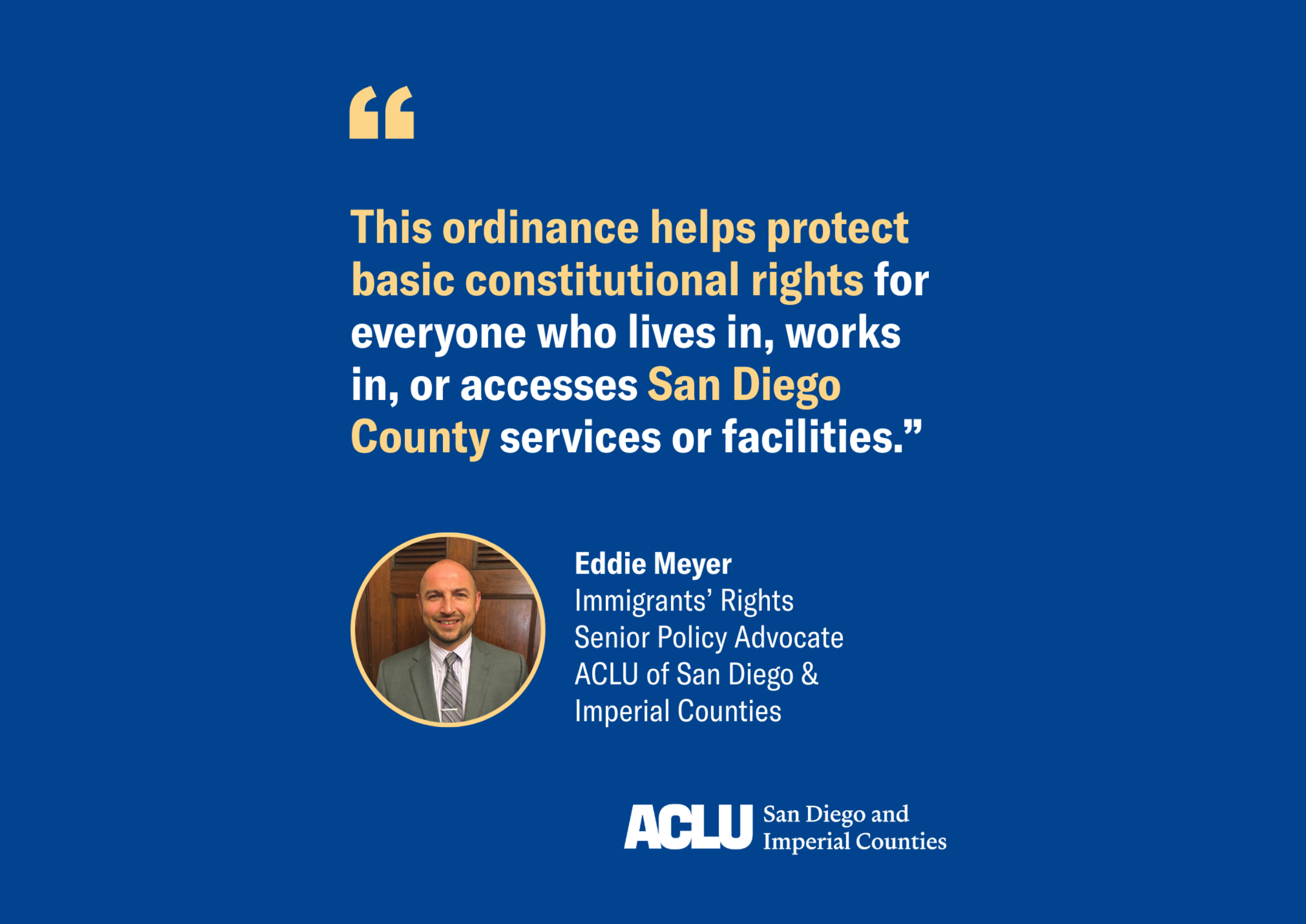
ACLU-SDIC Testimony – San Diego County Board of Supervisors Considers CLEAR Ordinance
By Eddie Meyer
Latest Press Release
ACLU-SDIC Launches EmpowerEd: A Three-Track Public Education Series



ACLU-SDIC Testimony – San Diego City Council Considers Whether to Continue Surveillance Use Policies
By Blair Overstreet
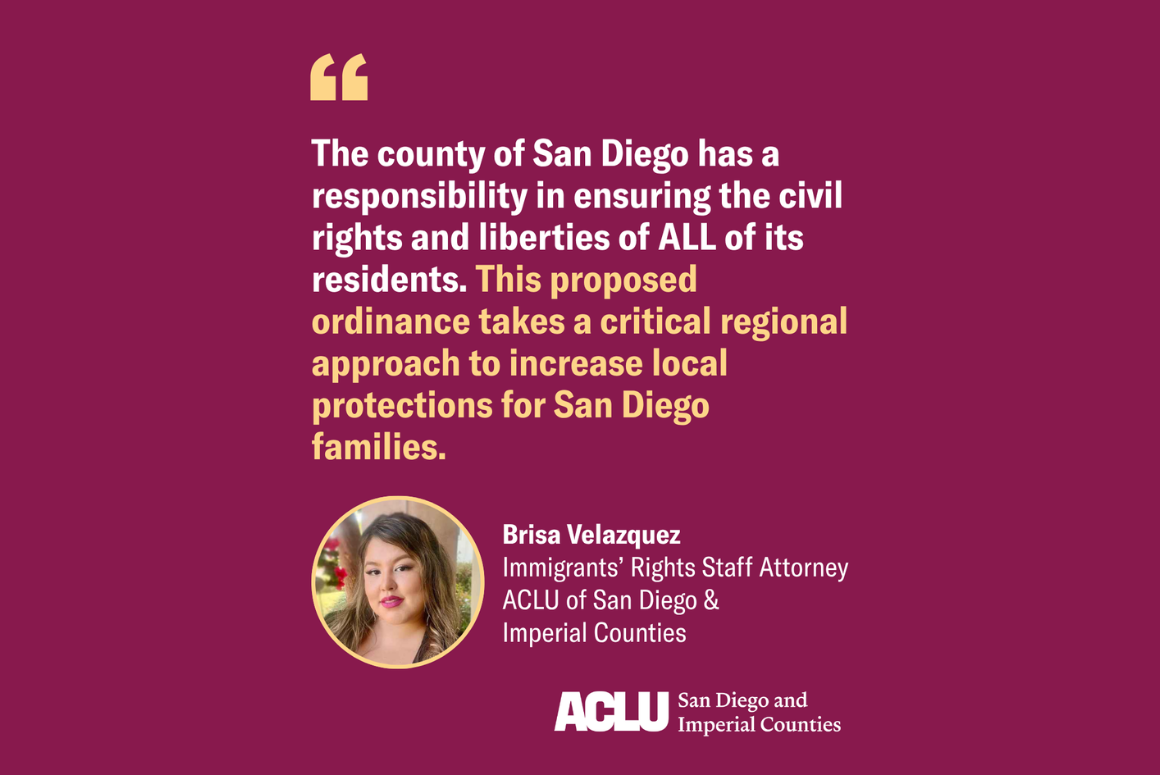
ACLU-SDIC Testimony – San Diego County Board of Supervisors Considers Drafting CLEAR Ordinance
By Brisa Velazquez
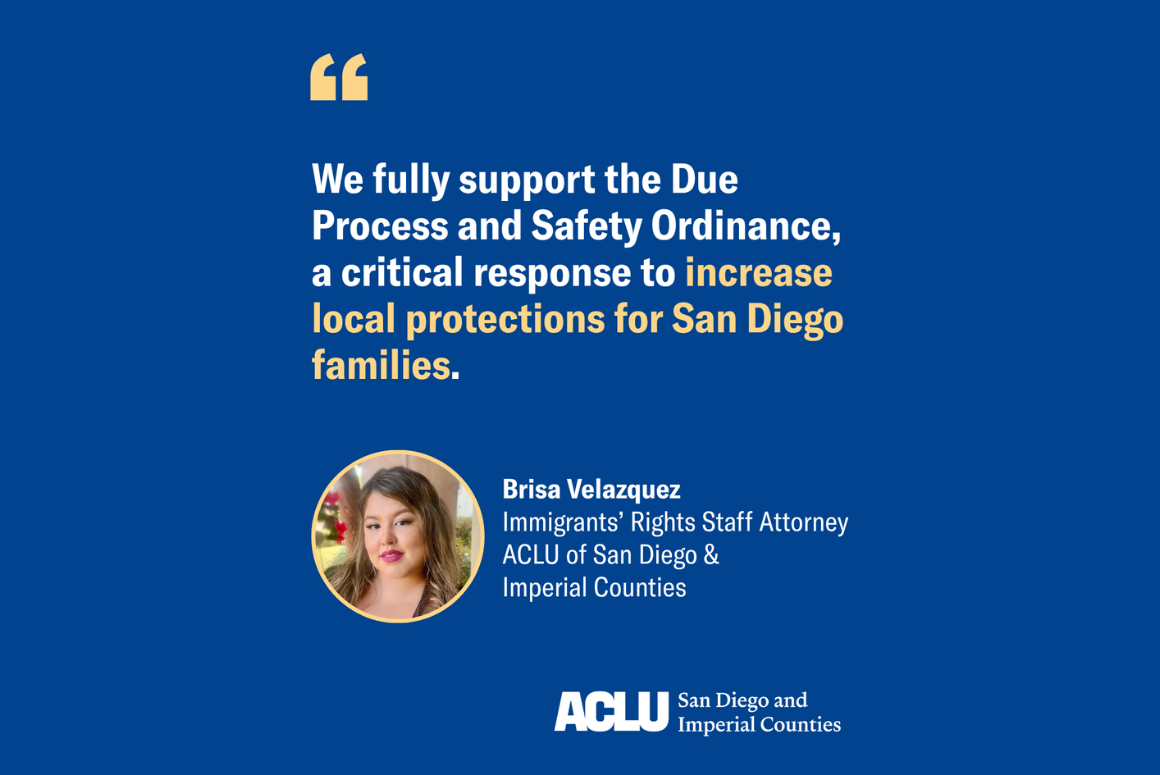
ACLU-SDIC Testimony – San Diego City Council Considers Due Process & Safety Ordinance
By Brisa Velazquez
Welcome to the Prop 8 Lawsuit Blog
Welcome to ACLU-San Diego's update blog on the litigation challenging Proposition 8. We are not aiming to blog at you too much. Rather we want to get you detailed information quickly.
Why?
We know that many people are following this important challenge very closely, and they want more information. We are hearing from members of the public gay and straight, married and unmarried who are deeply distressed.
Rightly so. Denying marriage equality strips couples of their right to be free from discrimination in exercising a fundamental right as the California Supreme Court recognized in its historic decision In Re Marriage Cases on May 15, 2008. But, Prop. 8 sought not only to reverse that progress. It also stripped every American of the confidence and security that every one of us is entitled to equal protection of the law.
That's why we have petitioned the California Supreme Court to hold Prop. 8 invalid. The case is called Strauss et al v. Horton et al.
Here's how to use this resource.
- First, bookmark this link: https://www.aclu-sdic.org/issues.php?sub_cat_sel=000098
- Or, select Prop. 8 Lawsuit Blog under the list of issues on the left hand side of our homepage: https://live-awp-san-diego.pantheonsite.io
We will post the legal briefs and court decisions, as well as provide other useful information. Already, you can find:
- A helpful overview of the litigation,
- The expected timeline of the case, and
- Legal documents related to the case.
If you have questions, let us know at prop8@aclusandiego.org.

Don't Chip Our Rights Away!
Radio Frequency Identification (RFID) tags are tiny computer chips that can be encoded with any type of information. These chips are embedded within documents or objects to be used for monitoring or tracking purposes. When an RFID reader emits a radio signal, the RFID tags in the vicinity respond by automatically transmitting their stored information to the reader, at a distance, without alerting anyone that the tag is being read.
RFID technology originally gained a foothold in the commercial sector as a means to allow real-time monitoring and tracking of cattle in the fields and inventory moving through the supply chain.
U.S. government initiated the rollout of RFID-embedded passports, and there are potential plans to embed RFID tags in other identification documents.
How does it really work? The information that has traditionally been printed on the face of ID cards, such as our name, address, and unique identifier number, is encoded on the chip in the card. Without adequate privacy and security protections, our personal information could be transmitted without our knowledge. That means that whether we are walking down the street, participating in a political rally, or visiting a doctor's office or a gun show, we are at risk of being tracked and stalked and of having our identity stolen.
The ACLU has been working to protect privacy, personal safety, and financial security and bring attention to the risks associated with the use of RFID technology in identification documents.
The Real ID Act
The Real ID Act was passed by Congress last year, with no hearings, as part of a must-pass military appropriations bill. Real ID will turn state driver's licenses into national identity cards, and impose numerous financial and bureaucratic burdens on taxpayers and state governments.
The act rolls back civil liberties protections, attacks privacy rights, and sets the stage for a national ID. Many diverse groups, including the ACLU, the National Council of State Legislatures, the National Governors Association, and the American Association of Motor Vehicle Administrators are opposed to the Real ID Act. Conservative estimates place the minimum cost of the program at $12 billion, and some believe it could cost at least double that.
Read more about the act in our Frequently Asked Questions.
Privacy Rights Are a Fundamental American Value
Justice Potter Stewart wrote that "The Fourth Amendment and the personal rights it secures have a long history. At the very core stands the right of a man to retreat into his own home and there be free from unreasonable government intrusion."
From using the telephone to seeking medical treatment to applying for a job or sending e-mail over the Internet, our right to privacy is in peril. Our personal and business information is being digitized through an ever-expanding number of computer networks in formats that allow data to be linked, transferred, shared and sold, usually without our knowledge or consent. The same technological advances that have brought enormous benefits to humankind also make us more vulnerable than ever before to unwanted snooping.
As technology provides new ways to gather information and databases proliferate, the need for privacy protections becomes more urgent. The ACLU is a national leader in working to guarantee that individuals may determine how and when others can gain access to their personal information.
PATRIOT ACT REAUTHORIZED BUT BATTLE FOR REFORM CONTINUES
In early 2006, Congress reauthorized the Patriot Act without fixing the law's most fundamental flaws. On March 9, 2006, President Bush signed the flawed reauthorization bill into law.
The ACLU is obviously disappointed with this outcome, the fight to reform the Patriot Act is far from over. Lawmakers have introduced legislation to ensure that needed changes are made to the Patriot Act, protecting our liberty and privacy. Both Congress and the courts are examining the National Security Letter (NSL) provisions of the act.
Additionally, Congress failed to include commonsense reforms to the Patriot Act that would target our precious anti-terrorism resources on suspected foreign terrorists rather than invading the privacy of innocent people through fishing expeditions into their financial, medical, library and Internet records. We need to contact our legislators and tell them to reprioritize our limited resources.
There are signs of progress in the mdist of it all. The Patriot Act debate has come a long way in the last four years. When the Senate first voted on the Patriot Act, only one Senator opposed it -- on this year's reauthorization vote, ten Senators opposed it. And a bipartisan group of 52 Senators stood up to the administration and filibustered the reauthorization bill late last year.
In the House, bipartisan majorities supported bills to limit the reach of the Patriot Act by placing better checks and balances into the law -- moves that were ultimately overridden by the Republican House leadership at the behest of the Bush administration's knee-jerk opposition to common-sense reforms.
Since the Patriot Act was first debated and passed, we've made tremendous progress. Thanks to your efforts, the White House was unable to secure the rubber stamp reauthorization and expansion of the Patriot Act it had hoped for. This debate over the need to protect our most fundamental freedoms laid the foundation for the public's rejection of the president's abuses of power, including the warrantless NSA program to spy on Americans. Now, more than ever, Americans are aware of the Bush administration's reckless policies, and they are speaking out.
If you are not already a member, please join our News & Action Network and/or Membership Action Squad to receive periodic updates and calls to action on issues as important as this one.
TORTURE AND DETENTION
The Bush Administration and Congress have ignored their obligation to end the torture and abuse of detainees in U.S. military custody and restore faith in America's commitment to human rights at home and around the world.
Visit the national ACLU's website to learn more about:
Good Government Requires Freedom of Information
Throughout our country's history, national security has often been used as a pretext for massive violations of individual rights. In the name of national security, President Jefferson countenanced internment camps for political dissidents; President Wilson authorized the round-up and deportation of thousands of foreign-born suspected "radicals" during the Palmer Raids; and President Franklin Roosevelt interned 120,000 Japanese Americans. The Cold War era brought loyalty oaths, blacklisting and travel restrictions; the Vietnam War era saw the government's attempt to censor the "Pentagon Papers". None of these measures were actually necessary to preserve national security; all of them violated civil liberties.
Since September 11, 2001, our government has introduced countless new security measures as part of its "war on terrorism." Unfortunately, many of these new measures are either ineffective, unnecessary, or both, and they violate civil liberties principles. Whether we are looking at secret arrests and detentions, national ID cards, facial recognition technology, military tribunals, the USA Patriot Act, racial profiling, or the TIPS program encouraging people to spy on one another, we see security measures that will not stop terrorism, but will require us to give up our freedom. Terrorism, by definition, is not just intended to kill and destroy, it is also intended to make us act in fear, and make choices against our best interests. The United States was founded on the principles of freedom, justice and equality; if we give up these beliefs because of fear, then terrorists will have won.
Open government is a cornerstone of democracy that enables advocates, activists and the press to monitor government performance and expose corruption. Without transparency in government activities, the American people are vulnerable to deception and abuse by our leaders.
Stay Informed
Sign up to be the first to hear about how to take action.
By completing this form, I agree to receive occasional emails per the terms of the ACLU’s privacy statement.
By completing this form, I agree to receive occasional emails per the terms of the ACLU’s privacy statement.