News & Commentary
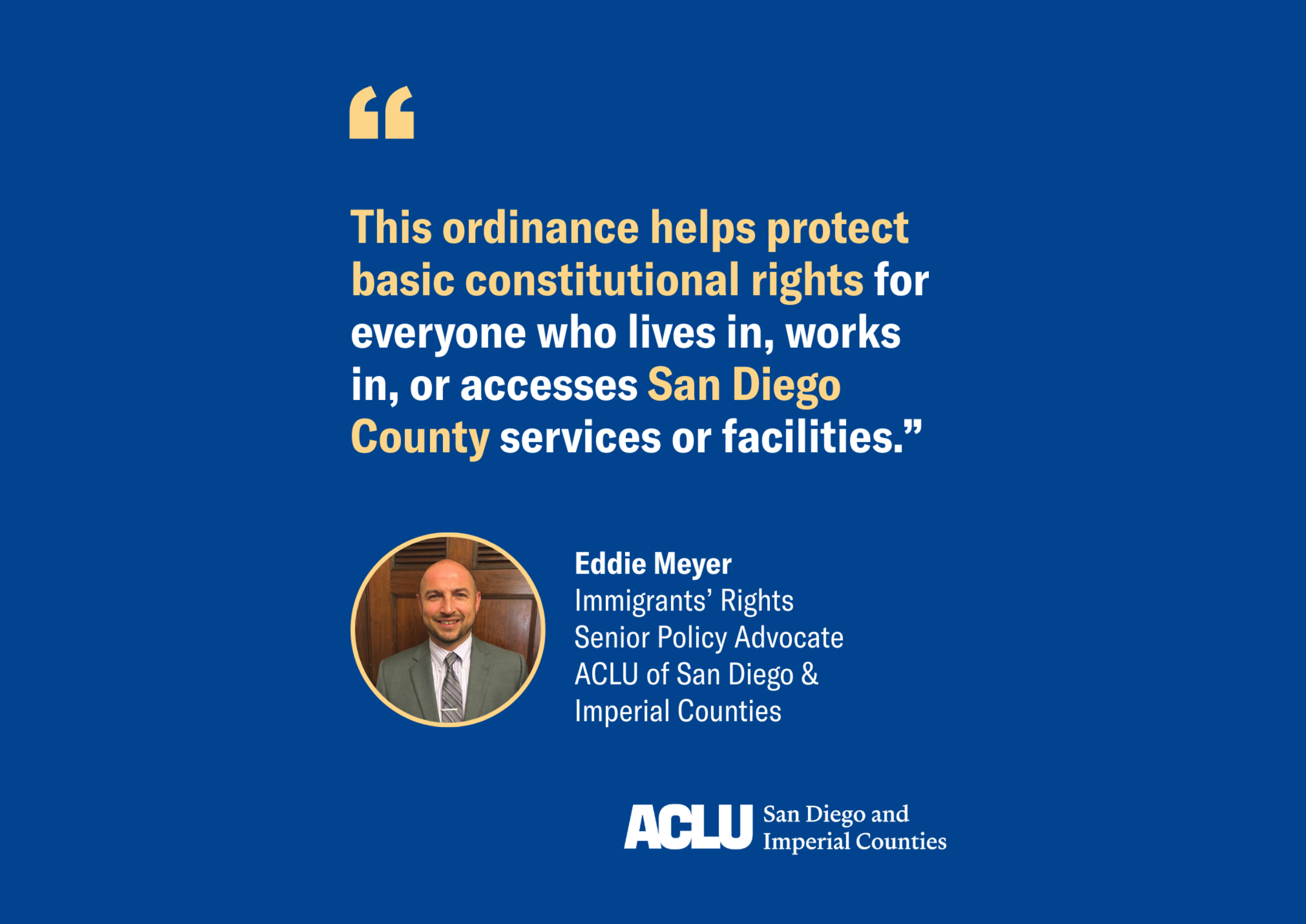
ACLU-SDIC Testimony – San Diego County Board of Supervisors Considers CLEAR Ordinance
By Eddie Meyer
Latest Press Release
ACLU-SDIC Launches EmpowerEd: A Three-Track Public Education Series

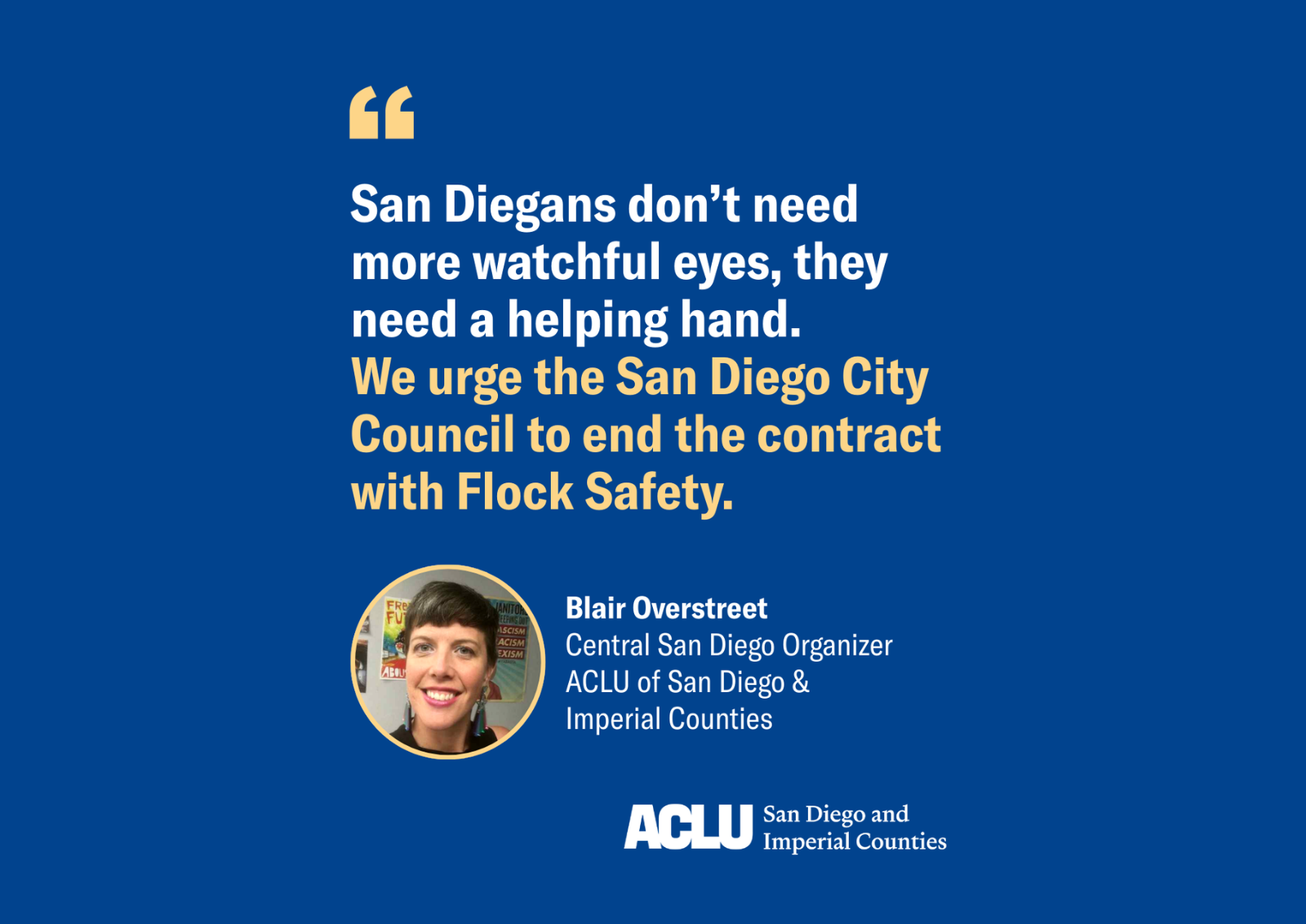
ACLU-SDIC Testimony – San Diego City Council Considers Whether to Continue Surveillance Use Policies
By Blair Overstreet
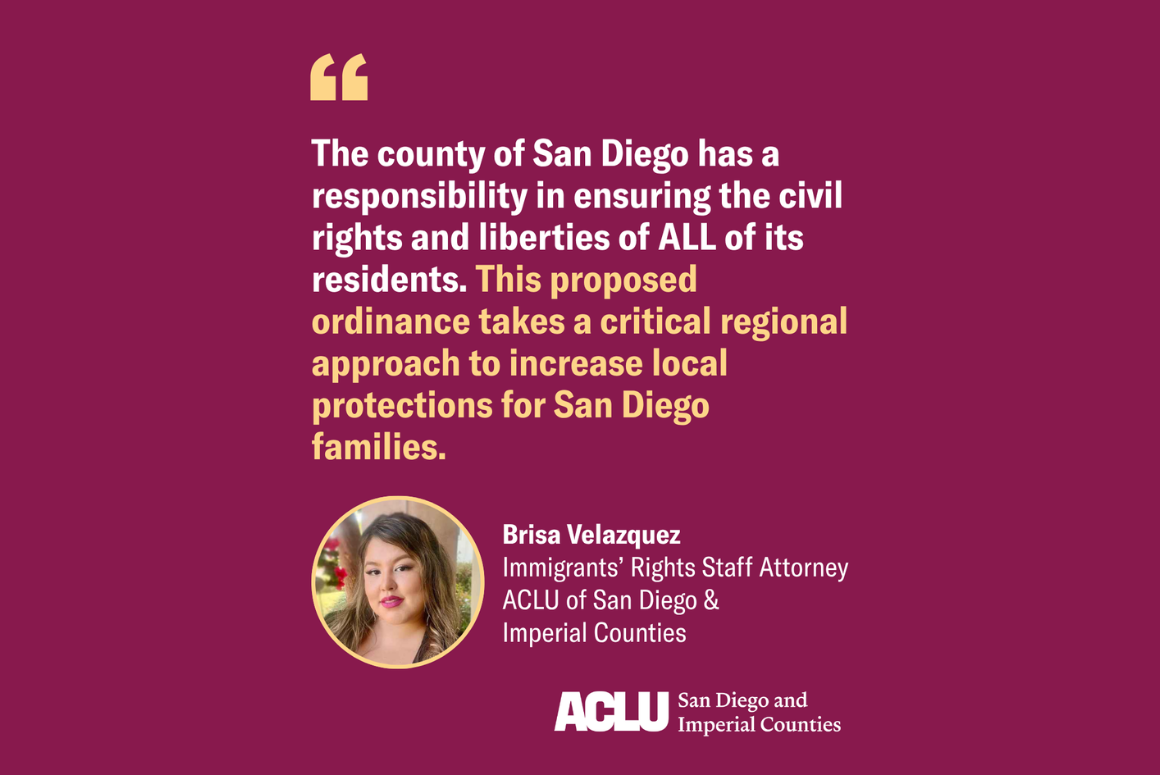
ACLU-SDIC Testimony – San Diego County Board of Supervisors Considers Drafting CLEAR Ordinance
By Brisa Velazquez
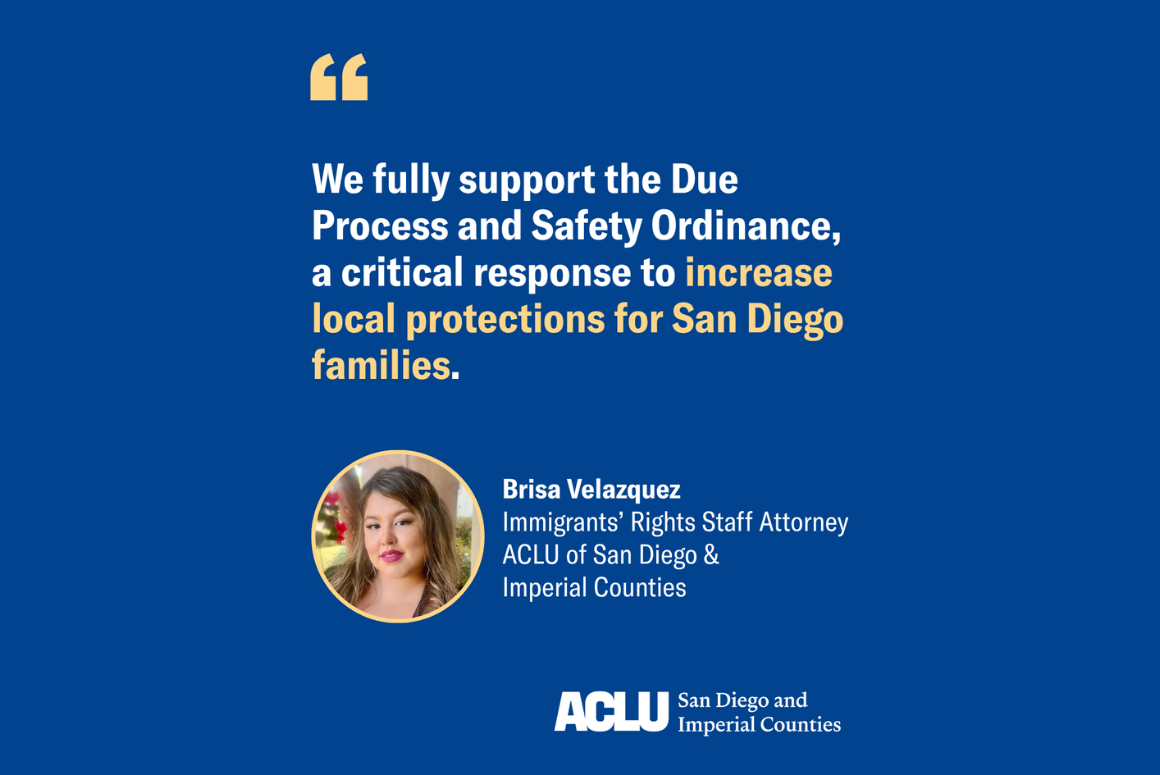
ACLU-SDIC Testimony – San Diego City Council Considers Due Process & Safety Ordinance
By Brisa Velazquez
The ACLU Mandate
The mission of the ACLU is to assure that the Bill of Rights - amendments to the Constitution that guard against unwarranted governmental control - is preserved for each new generation. To understand the ACLU's purpose, it is important to distinguish between the Constitution and the Bill of Rights. The Constitution itself, whose bicentennial we celebrated in 1987, authorizes the government to act. The Bill of Rights limits that authority.
The Bill of Rights lays out the guiding principles of our democratic government: freedom and equality for all. It serves as the ACLU's blueprint for action today just as it has since our inception in 1920.
At our founding, the Constitution and the Bill of Rights were nearly 150 years old, yet people could not freely exercise many of the rights the Constitution guaranteed. People were denied the right to demonstrate publicly. There was no curb against censorship. Women's rights were unprotected. Racial discrimination was open and legal. There was no due process for the accused, and little protection for religious freedom. By winning one precedent-setting case after another, the ACLU has established the vast majority of civil liberties in the land.
First Amendment rights:
These include freedom of speech, association and assembly, freedom of the press, and freedom of religion, including the strict separation between church and state which is the foundation of religious liberty.
Equal protection of the law:
The right to equal treatment regardless of race, sex, religion, national origin, sexual orientation, age, physical disability, or other such classification. These rights apply to the voting booth, the classroom, the workplace and the courts.
Due process of law:
The right to be treated fairly when facing criminal charges or other serious accusations that can result in such penalties as loss of employment, exclusion from school, denial of housing, or cut-off of benefits.
The right to privacy:
The right to a guaranteed zone of personal privacy and autonomy which cannot be penetrated by the government or by other institutions, like employers, with substantial influence over an individual's rights.
Expanding those protections:
Although some segments of our population have traditionally been denied these rights, the ACLU works to extend protection to racial minorities, gay men and lesbians, mental patients, prisoners, soldiers, children in the custody of the state, the disabled, and Native Americans.

1960 Flashback 40th Anniversary Issue of ACLU'S Civil Liberties Newsletter
2010 is the ACLU's 90th Anniversary. Here is how the organization looked at its 40th Anniverary in 1960. The Palmer Raids, The Scopes Case, Upton Sinclair, The Scottsboro Boys, and on and on.
In fact, if you look carefully, you'll notice this is the issue that was sent to the founder of the San Diego ACLU, Helen Marston Beardsley.
On A.L. Wirin - One of Our Legends
Note: The following column by Paul Weeks was published several months before veteran newsman Weeks passed away at age 86. It is only one man's view of legendary ACLU attorney A.L. Wirin, but it is compelling.
Lawyer fought for all rights
By Paul Weeks
May 01, 2007
The Record
'The rights of all persons are wrapped in the same constitutional bundle as those of the most hated member of the community."
That's what A.L. Wirin said, and that's what he practiced in serving as chief counsel of the American Civil Liberties Union of Southern California for four decades.
It was more than a half-century ago when my phone rang in the city room of the old Los Angeles Mirror. A Superior Court judge had read a piece I had written about American Indians' use of peyote, a hallucinogenic drug, in religious rites. Would I come over and talk to him about it?
A young Navajo had been arrested for possession of peyote and was facing a possible jail sentence. The judge was troubled. I knew a lawyer who would represent the man for free: A.L. Wirin.
Al agreed because he always championed the Constitution, including freedom of religion, which he held as sacred as reporters hold freedom of the press.
Ironically, if the young man had pleaded guilty, the judge might have let him go home with only a scar on his record as a criminal. Instead, he was held in jail for three weeks while the judge heard Wirin's defense.
It was so convincing that the judge wrote a 30-page opinion that the accused's religion exempted him from the law. California then amended its drug law to accommodate the religious rights of American Indians.
Al and I crossed paths in the nation's capitol when he was defending Linus Pauling, the scientist and peace activist, against zealots who accused him of communist connections. Pauling was the only man to win the Nobel Prize in two different fields - first, for chemistry, and second, for peace.
Ed Cray, who worked for the ACLU in Wirin's time, told me that Sirhan Sirhan, charged in 1968 with the assassination of Robert Kennedy, sought an ACLU lawyer to defend him. When the anti-Semitic Sirhan found that Wirin was a Jew, neither wanted any further relations. Wirin, following the ethic that everyone is innocent until proven guilty, recommended Grant Cooper to defend Sirhan.
Wirin even defended a notorious fascist demagogue, the Rev. Gerald L.K. Smith, who had been refused the right to speak before a Glendale High School audience. Al won Smith's right to speak - and then joined the picket line protesting Smith's views.
Wirin was the son of Jewish immigrants who had fled Russia during the pogroms. He always signed himself "A.L. Wirin," never revealing the names that went with the initials.
But I found out. Al's parents had named him Abraham Lincoln Wirin, in honor of the Great Emancipator.
When I called the ACLU in Los Angeles to learn when he had died, the young media relations person, only three weeks on the job, had never heard of Wirin. He died of a stroke in Hollywood in 1978 at the age of 77.
He must never be forgotten.
How the ACLU Works
The ACLU is a 50-state network of staffed affiliate offices in most major cities, more than 300 chapters in smaller towns, and regional offices in Denver and Atlanta. Work is coordinated by a national office in New York, aided by a legislative office in Washington that lobbies Congress. The ACLU has more than a dozen national projects devoted to specific civil liberties issues: AIDS, arts censorship, capital punishment, children's rights, education reform, lesbian and gay rights, immigrants' rights, national security, privacy and technology, prisoners' rights, reproductive freedom, voting rights, women's rights and workplace rights.
The ACLU has more than 60 staff attorneys, who collaborate with at least 2,000 volunteer attorneys in handling close to 6,000 cases annually -- making the ACLU the largest public interest law firm in the nation. The ACLU appears before the U.S. Supreme Court more than any other organization except the U.S. Department of Justice.
"So long as we have enough people in this country willing to fight for their rights, we'll be called a democracy."
ACLU founder Roger Baldwin
The ACLU is governed by an 84-member national Board of Directors which has one representative from each state affiliate and 30 at-large members elected by the affiliate and national boards. The affiliate boards, in turn, are elected by all ACLU members within their jurisdiction. On a day-to-day basis, each affiliate is autonomous and makes its own decisions about which cases to take and which issues to emphasize. They collaborate with the national office in pursuit of common goals.
Click here to learn more about ACLU affiliates across the country.
Founding of the ACLU
When Roger Baldwin founded the ACLU in 1920, civil liberties were in a sorry state. Citizens were sitting in jail for holding antiwar views. U.S. Attorney General Palmer was conducting raids upon aliens suspected of holding unorthodox opinions. Racial segregation was the law of the land and violence against blacks was routine. Sex discrimination was firmly institutionalized; it wasn't until 1920 that women even got the vote. Constitutional rights for gays and lesbians, the poor, prisoners, mental patients, and other special groups were literally unthinkable. And, perhaps most significantly, the Supreme Court had yet to uphold a single free speech claim under the First Amendment.
"We must remember that a right lost to one is lost to all. The ACLU remembers and it acts. The cause it serves so well is an imperative of freedom." - William Reece Smith, Jr., former president, American Bar Association
The ACLU was the first public interest law firm of its kind, and immediately began the work of transforming the ideals contained in the Bill of Rights into living, breathing realities.
ACLU: Protecting American Values and Fundamental Freedoms for All
We invite you to take pride in protecting fundamental American values of freedom, fairness, and equality for all by becoming a proud card-carrying member of the ACLU. Our work sticking up for the little guy is part of a great American tradition.
The ACLU works daily in the courts, legislatures and communities to defend and preserve the rights and freedoms our founders guaranteed in the Constitution, Bill of Rights, and the laws of the United States.
WHO WE ARE
We are a nonprofit, nonpartisan organization that reaches out to and represents anyone whose fundamental freedoms have been violated. We are the largest organization defending civil rights and civil liberties in the world.
The ACLU protects American values and preserves American freedoms. Our job is to conserve America's civic values - as expressed in the Constitution and the Bill of Rights - and defend these rights even when its unpopular to do so.
Protecting the freedoms of those with whom the majority disagrees or despises is the only way to keep those precious rights alive for future generations. Sticking up for the little guy is fundamental to preserving the integrity of our democracy.
HOW LARGE?
The ACLU's work is sustained by more than 500,000 members and supporters who play an active role in defending freedom.
Advocate of Individual Rights
The American Civil Liberties Union is the nation's foremost advocate of individual rights - litigating, legislating, and educating the public on a broad array of issues affecting individual freedom in the United States. The ACLU has won important victories in a range of cases.
The American system of government is built on two basic, counterbalancing principles: 1) that the majority of the people, through democratically elected representatives, governs the country and 2) that the power of even a democratic majority must be limited to insure individual rights. In every era of American history, the government has tried to expand its authority at the expense of individual rights. The American Civil Liberties Union exists to make sure that doesn't happen, and to fight back when it does.
The ACLU is not a public defender like Legal Services or Legal Aid. It does not handle criminal cases or civil disputes or choose sides according to financial criteria. Nor do we take political sides; we are neither liberal nor conservative, Republican nor Democrat. The ACLU is a nonprofit, nonpartisan, 500,000-member public interest organization devoted exclusively to protecting the basic civil liberties of all Americans, and extending them to groups that have traditionally been denied them. In its nine decades of existence, the ACLU has become a national institution, and is widely recognized as the country's foremost advocate of individual rights.
If you believe your civil liberties have been violated, contact your local ACLU affiliate, the ACLU of San Diego & Imperial Counties, at P.O. Box 87131, San Diego, CA 92138-7131, 619/232-2121.
Spoken Word Artists Slam for Free Speech
The First Amendment says, Congress shall make no law respecting an establishment of religion, or prohibiting the free exercise thereof; or abridging the freedom of speech, or of the press; or the right of the people peaceably to assemble, and to petition the Government for a redress of grievances.
Unabridged, from spoken word artists Steve Connell and Sekou (tha misfit), is a new collection of poetry written especially for the ACLU that celebrates the power of words and captures the passion behind several of our current battles in the courtrooms and in Congress.
Listen in and stay tuned for more...
Students Are NOT Second-Class Citizens!
In spite of the Supreme Court's ringing endorsement of students' rights in the landmark Tinker decision, constitutional violations are far too common in public schools across the country. Articles about controversial subjects written for student newspapers are censored. Lockers and backpacks are searched without reasonable suspicion. Minority students are disproportionately directed to lower track programs. Majoritarian religious practices are officially sanctioned by teachers and school administrators. Female students are excluded from certain extracurricular activities, and gay students are intimidated into silence.
Teachers and administrators have a responsibility to provide a safe environment for the students that is conducive to learning. They also have a responsibility to respect each student's individual rights. These two missions are not incompatible. Kids have rights too!
Stay Informed
Sign up to be the first to hear about how to take action.
By completing this form, I agree to receive occasional emails per the terms of the ACLU’s privacy statement.
By completing this form, I agree to receive occasional emails per the terms of the ACLU’s privacy statement.