News & Commentary
ACLU-SDIC Public Comment – City of San Diego Risk Management Presents on Settlements & Judgments Against SDPD
By Branden Sigua


ACLU-SDIC Public Comment – City of San Diego Holds Hearing on Approval of FY27 Budget
By Branden Sigua


New Legislation Increases Transparency in Law Enforcement Records
# # #
WHAT SUPPORTERS ARE SAYING ABOUT SB 1286
San Francisco Public Defender Jeff Adachi
Citizens frequently entrust their lives to police officers. In return, we ask for transparency,” said San Francisco Public Defender Jeff Adachi. “Senator Leno’s proposed legislation will allow public access to information regarding officers who have been found to use excessive force and other misconduct. This bill provides potentially life-saving information to citizens while boosting accountability for police departments. In San Francisco, officers with serious misconduct records that should have disqualified them from duty have gone on to harm city residents. Sen. Leno’s bill will help prevent future tragedies."
San Francisco Supervisor Malia Cohen
I applaud Senator Leno for prioritizing transparency and accountability in law enforcement. This legislation is key for strengthening and building trust with the public," said Supervisor Malia Cohen. "San Francisco is already helping pave the way for accessibility to this critical information. If we are not keeping track of this data, then we can't move forward."
San Francisco Police Commissioner L. Julius M. Turman
Being transparent with the public about proven misconduct of our officers, not mere allegations or claims, is not only in step with modern policing, but it demonstrates a level of respect and openness for our community and their right to know who is serving them,” said San Francisco Police Commissioner L. Julius M. Turman. “SB 1286 is necessary to ensure public trust and confidence in our police force.”
California Public Defenders Association (CDPA)
The California Public Defenders Association supports the public’s right to know about police officers who violate the public trust," said Margo George, co-chair of the CPDA legislative committee.
Conference of California Bar Associations (CCBA)
Current law, as interpreted by the Copley Press decision, prevents the public from knowing the depth and extent of misconduct and discipline of police and correctional officers,” said Larry Doyle, Legislative Representative for CCBA. “This undermines public efforts to achieve police accountability and to deter future misconduct. But it also undermines public trust in law enforcement by perpetuating the belief that misconduct is so pervasive that it must be completely shielded from the public eyes. In both these regards, the greater transparency provided by Senator Leno's bill will benefit both the public and law enforcement.”
For San Diego Police Department, Body Cameras Not Translating into Transparency
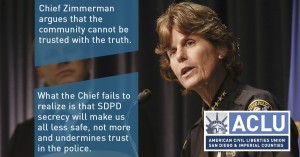
Chief Zimmerman this week went so far as to urge a court to deny a request for release of a recent security camera video footage that captured a fatal officer-involved shooting. In her declaration to the court, the Chief argues that the community cannot be trusted with the truth. It would be too dangerous, she claims, to allow the public to view the video that captured a fatal shooting by an SDPD officer in a dark alley in the Midway District earlier this year.
What the Chief fails to realize is that SDPD secrecy will make us all less safe, not more and undermines trust in the police.
The ACLU has repeatedly urged the Department to release the video to demonstrate its commitment to transparency. Despite the Chief’s claims, the release of the video would not hamper investigation into the shooting nor would it threaten the privacy of any other party. The officer and Fridoon Rawshan Nehad, who died there, were alone in that alley. The officer inexplicably and in violation of SDPD policy failed to turn on his body camera.
In this case, the public’s interest in understanding what happened clearly outweighs the privacy interests of those involved. A man is dead; the involved officer has already been identified. The video will simply show what happened. The Department’s decision to urge the court to keep the video hidden sends a strong message that the SDPD is more interested in circling the wagons than committing to transparency with the community it serves.
David Trujillo is Advocacy Director for the ACLU of San Diego & Imperial Counties.


Stay Informed
Sign up to be the first to hear about how to take action.
By completing this form, I agree to receive occasional emails per the terms of the ACLU’s privacy statement.
By completing this form, I agree to receive occasional emails per the terms of the ACLU’s privacy statement.