News & Commentary
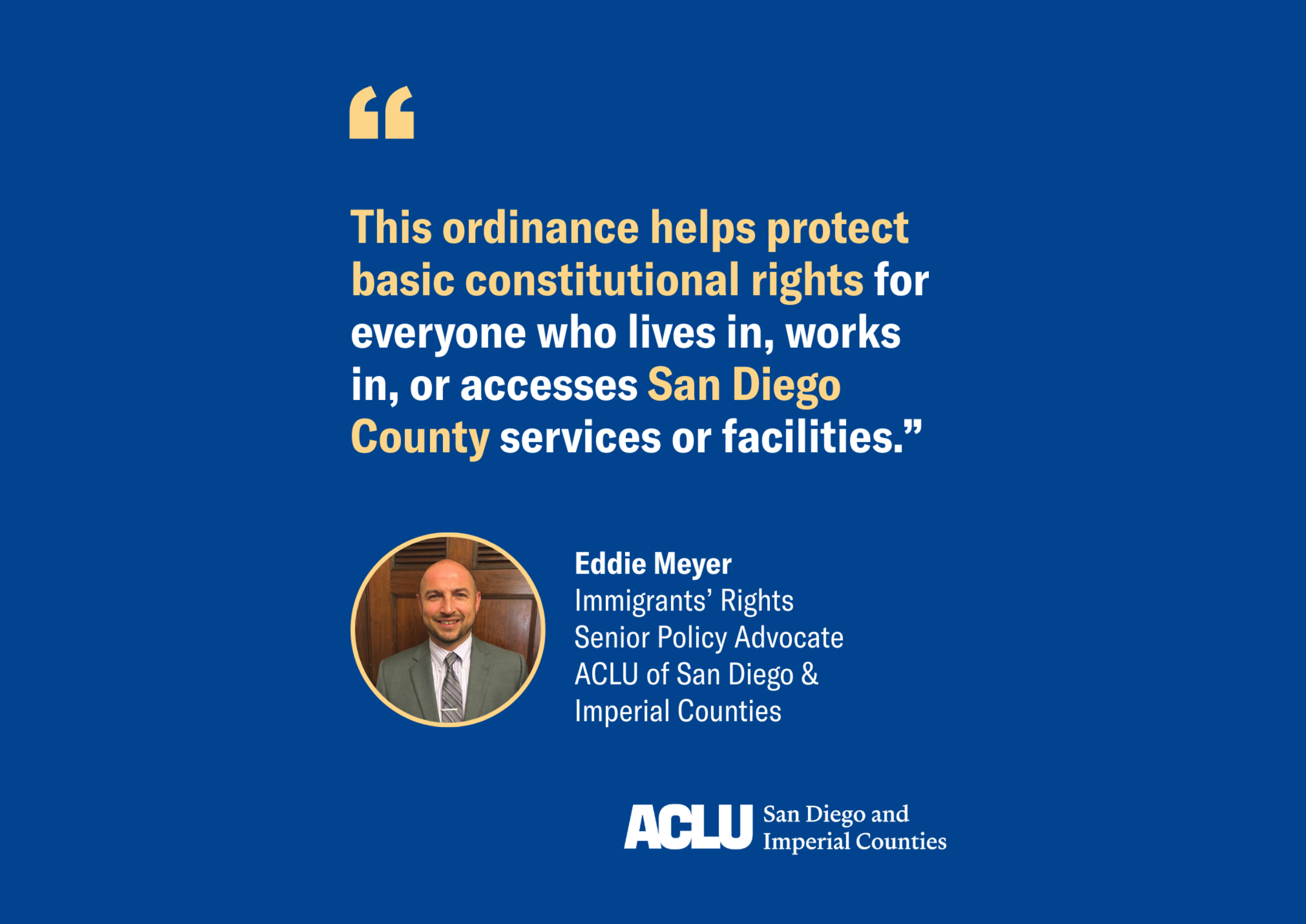
ACLU-SDIC Testimony – San Diego County Board of Supervisors Considers CLEAR Ordinance
By Eddie Meyer
Latest Press Release
ACLU-SDIC Launches EmpowerEd: A Three-Track Public Education Series


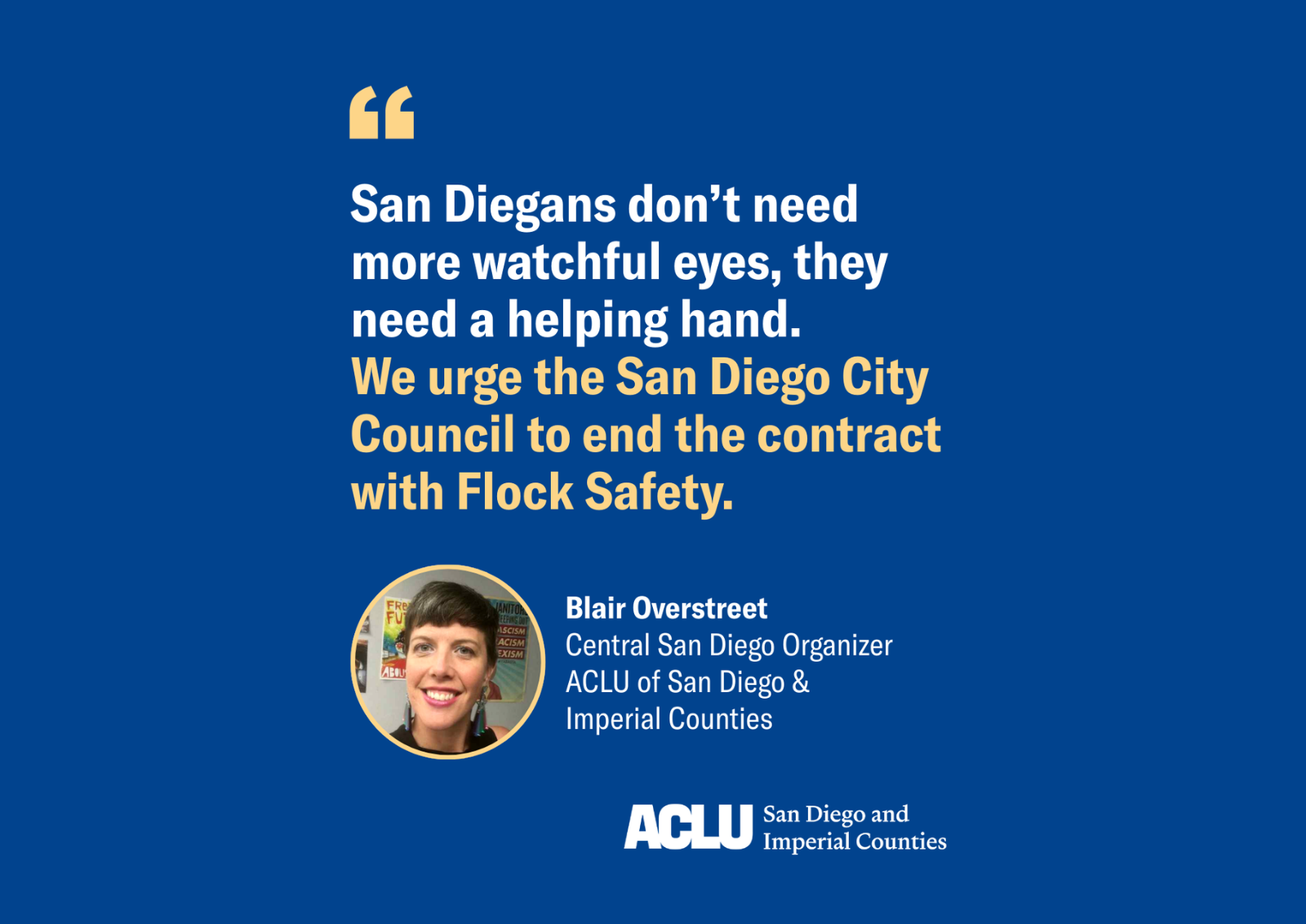
ACLU-SDIC Testimony – San Diego City Council Considers Whether to Continue Surveillance Use Policies
By Blair Overstreet
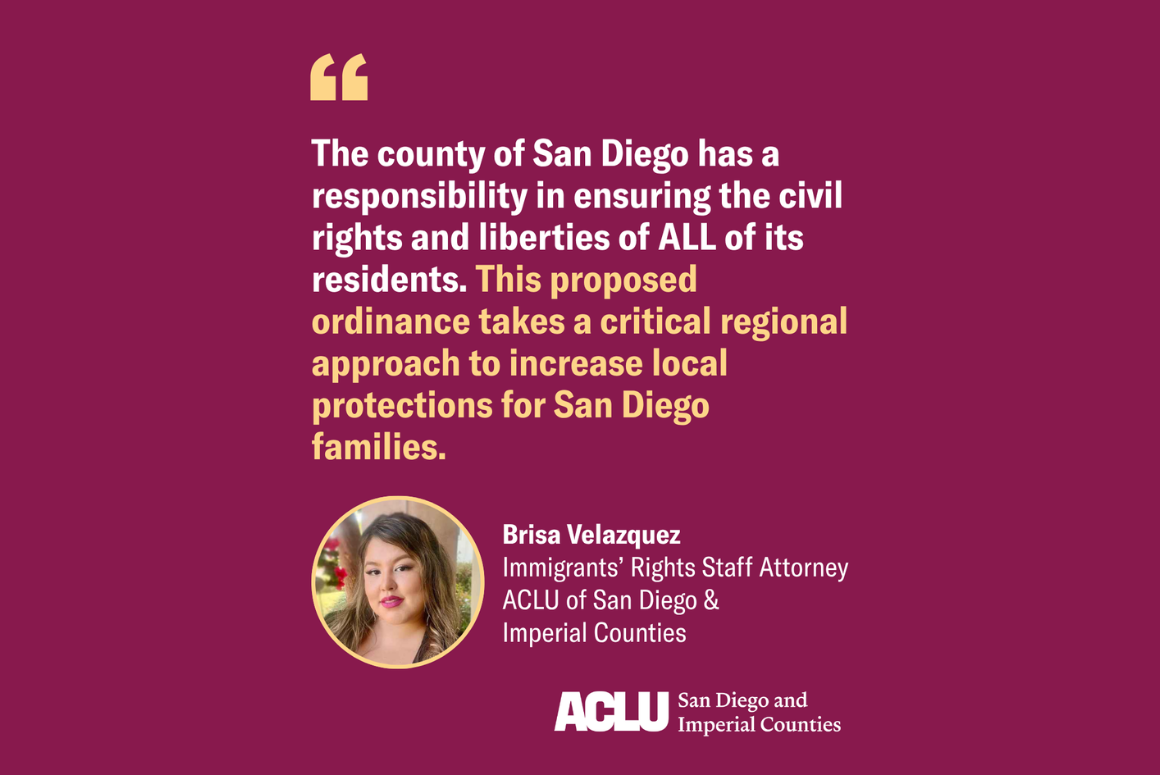
ACLU-SDIC Testimony – San Diego County Board of Supervisors Considers Drafting CLEAR Ordinance
By Brisa Velazquez
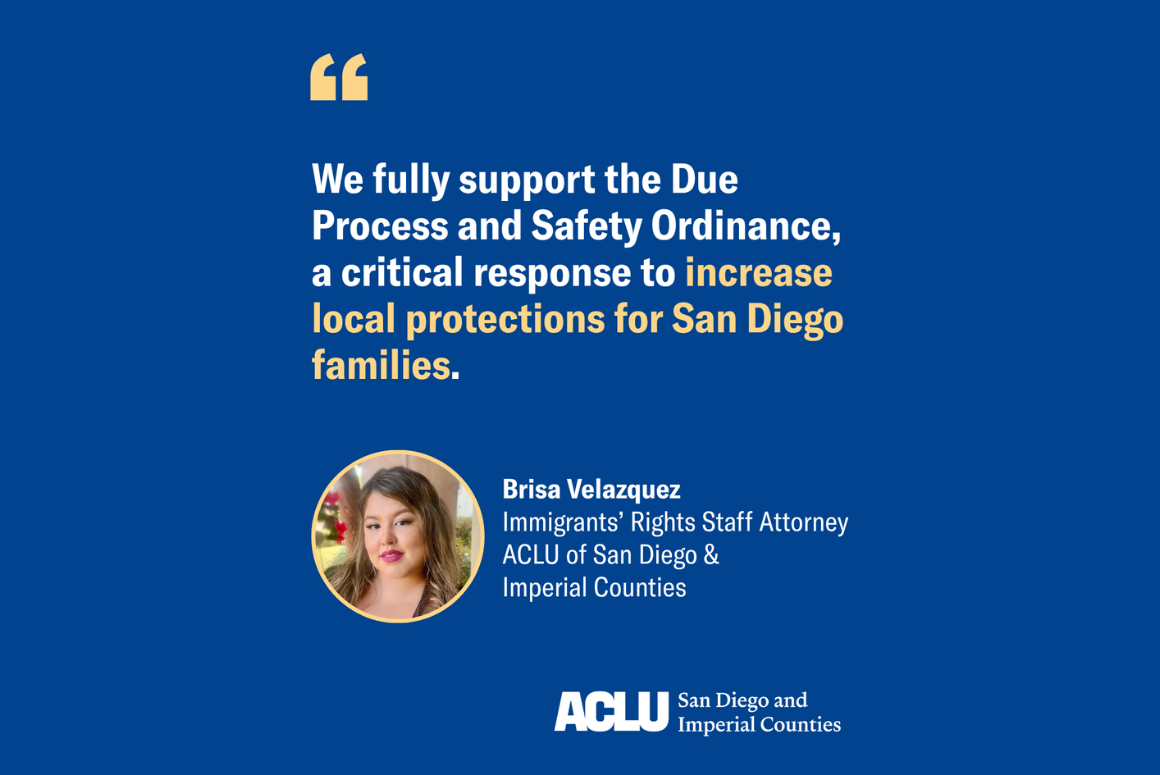
ACLU-SDIC Testimony – San Diego City Council Considers Due Process & Safety Ordinance
By Brisa Velazquez
ACLU and Border Coalition Seek Open Public Record in Anastasio Hernandez Rojas Civil Suit

ACLU Challenges NSA's Patriot Act Phone Surveillance
Last week, The Guardian released an order issued by the FISC that compelled a Verizon subsidiary—Verizon Business Network Services (VBNS)—to hand over, on an "ongoing, daily basis," details for every phone call placed on its network for a prospective three-month period. Collecting those details—"metadata" that reveals who people talk to, for how long, how often, and possibly from where—allows the government to paint an alarmingly detailed picture of Americans' private lives. The FISC order cited Section 215 as its legal basis, yet the breadth of the authority it granted to the government is simply incompatible with the text of the statute.
As an organization that advocates for and litigates to defend the civil liberties of society's most vulnerable, the staff at the ACLU naturally use the phone—a lot—to talk about sensitive and confidential topics with clients, legislators, whistleblowers, and ACLU members. And since the ACLU is a VBNS customer, we were immediately confronted with the harmful impact that such broad surveillance would have on our legal and advocacy work. So we're acting quickly to get into court to challenge the government's abuse of Section 215.
The ACLU's complaint explains that the dragnet surveillance the government is carrying out under Section 215 infringes upon the ACLU's First Amendment rights, including the twin liberties of free expression and free association. The nature of the ACLU's work—in areas like access to reproductive services, racial discrimination, the rights of immigrants, national security, and more—means that many of the people who call the ACLU wish to keep their contact with the organization confidential. Yet if the government is collecting

Scores of Privacy Groups to Government: Halt Secret Spying
We are calling on Congress to take immediate action to halt this surveillance and provide a full public accounting of the NSA’s and the FBI’s data collection programs. We call on Congress to immediately and publicly:
1. Enact reform this Congress to Section 215 of the USA PATRIOT Act, the state secrets privilege, and the FISA Amendments Act to make clear that blanket surveillance of the Internet activity and phone records of any person residing in the U.S. is prohibited by law and that violations can be reviewed in adversarial proceedings before a public court;
2. Create a special committee to investigate, report, and reveal to the public the extent of this domestic spying. This committee should create specific recommendations for legal and regulatory reform to end unconstitutional surveillance;
3. Hold accountable those public officials who are found to be responsible for this unconstitutional surveillance.
Thank you for your attention to this matter.
Sincerely,
4Chan, Access, Advocacy for Principled Action in Government, American Booksellers Foundation for Free Expression, American Civil Liberties Union, American Civil Liberties Union of California, American Library Association, Amicus, Association of Research Libraries, Bill of Rights Defense Committee, BoingBoing, Breadpig, Calyx Institute, Canvas, Center for Democracy and Technology, Center for Digital Democracy, Center for Financial Privacy and Human Rights, Center for Media and Democracy, Center for Media Justice, Competitive Enterprise Institute, Consumer Action, Consumer Watchdog, CorpWatch, CREDO Mobile, Cyber Privacy Project, Daily Kos, Defending Dissent Foundation, Demand Progress, Detroit Digital Justice Coalition, Digital Fourth, Downsize DC, DuckDuckGo, Electronic Frontier Foundation, Entertainment Consumers Association, Fight for the Future, Floor64, Foundation for Innovation and Internet Freedom, Free Press, Free Software Foundation, Freedom of the Press Foundation, FreedomWorks, Friends of Privacy USA, Get FISA Right, Government Accountability Project, Greenpeace USA, Institute of Popular Education of Southern California (IDEPSCA), Internet Archive, isen.com, LLC, Knowledge Ecology International (KEI), Law Life Culture, Liberty Coalition, May First/People Link, Media Alliance, Media Mobilizing Project, Philadelphia, Mozilla, Namecheap, National Coalition Against Censorship, New Sanctuary Coalition of NYC, Open Technology Institute, OpenMedia.org, Participatory Politics Foundation, Patient Privacy Rights, People for the American Way, Personal Democracy Media, PolitiHacks, Privacy and Access Council of Canada, Public Interest Advocacy Centre (Ottawa, Canada), Public Knowledge, Privacy Activism, Privacy Camp, Privacy Rights Clearinghouse, Privacy Times, reddit, Represent.us, Rights Working Group, Rocky Mountain Civil Liberties Association, RootsAction.org, Samuelson-Glushko Canadian Internet Policy &



ACLU Class Action Lawsuit Challenges Immigration Enforcement Agencies’ Practices of Tearing Families Apart
SAN DIEGO — Using misinformation, deception, and coercion, Border Patrol and ICE officers have pressured hundreds, if not thousands, of Mexican nationals with deep roots here in the United States into forfeiting their right to a fair hearing and a chance to live here lawfully, alleges the ACLU in a lawsuit being filed today in federal court in Los Angeles. The lawsuit, Lopez-Venegas v. Napolitano, alleges that as a matter of regular practice, Border Patrol agents and ICE officers pressure undocumented immigrants to sign what amounts to their own summary expulsion documents. The procedure is formally known as “voluntary departure,” but it regularly results in the involuntary waiver of core due process rights. An individual who signs for voluntary departure immediately surrenders his or her rights to a hearing before an immigration judge and is usually expelled to Mexico within a matter of hours.
Stay Informed
Sign up to be the first to hear about how to take action.
By completing this form, I agree to receive occasional emails per the terms of the ACLU’s privacy statement.
By completing this form, I agree to receive occasional emails per the terms of the ACLU’s privacy statement.