News & Commentary
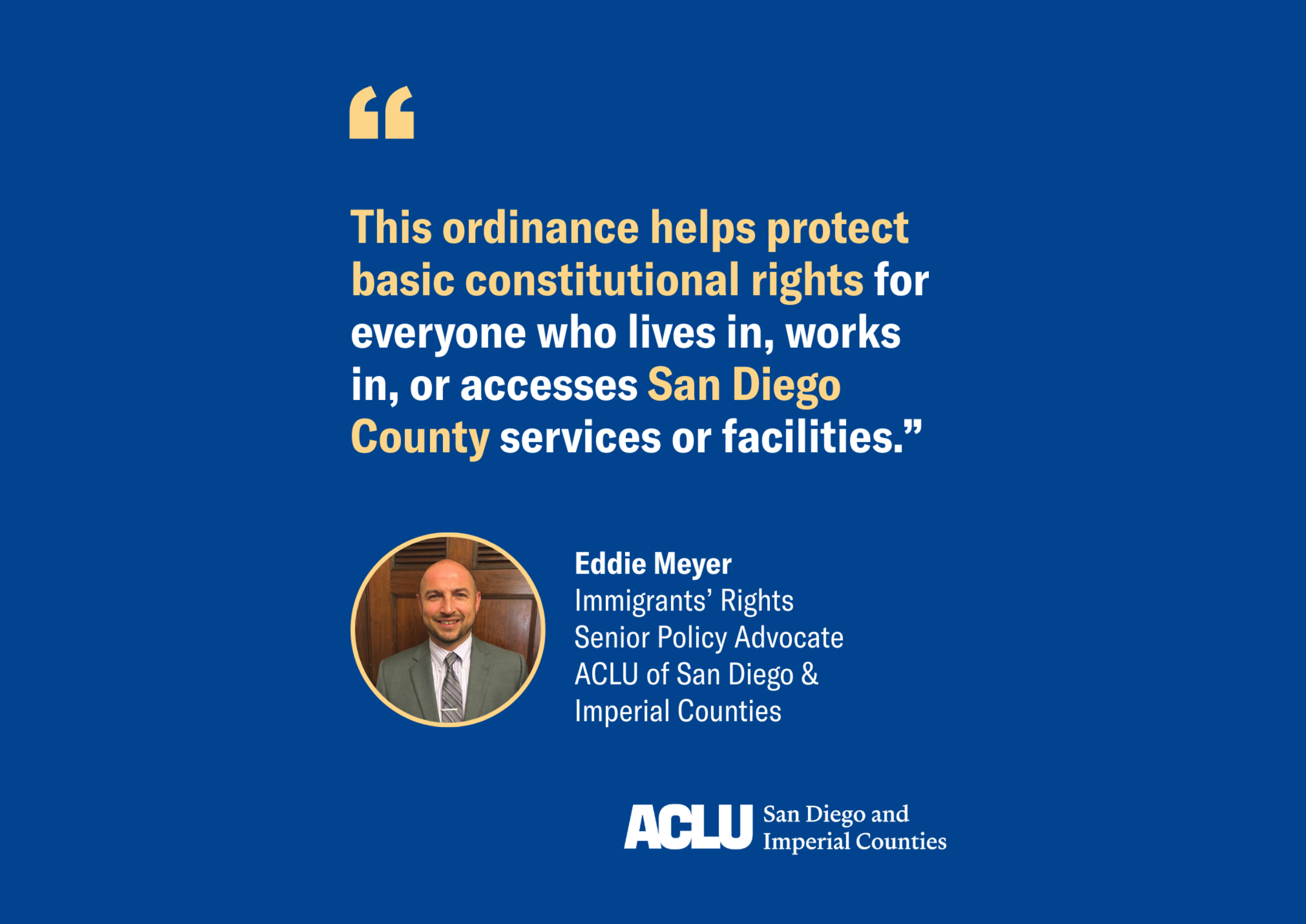
ACLU-SDIC Testimony – San Diego County Board of Supervisors Considers CLEAR Ordinance
By Eddie Meyer
Latest Press Release
ACLU-SDIC Launches EmpowerEd: A Three-Track Public Education Series


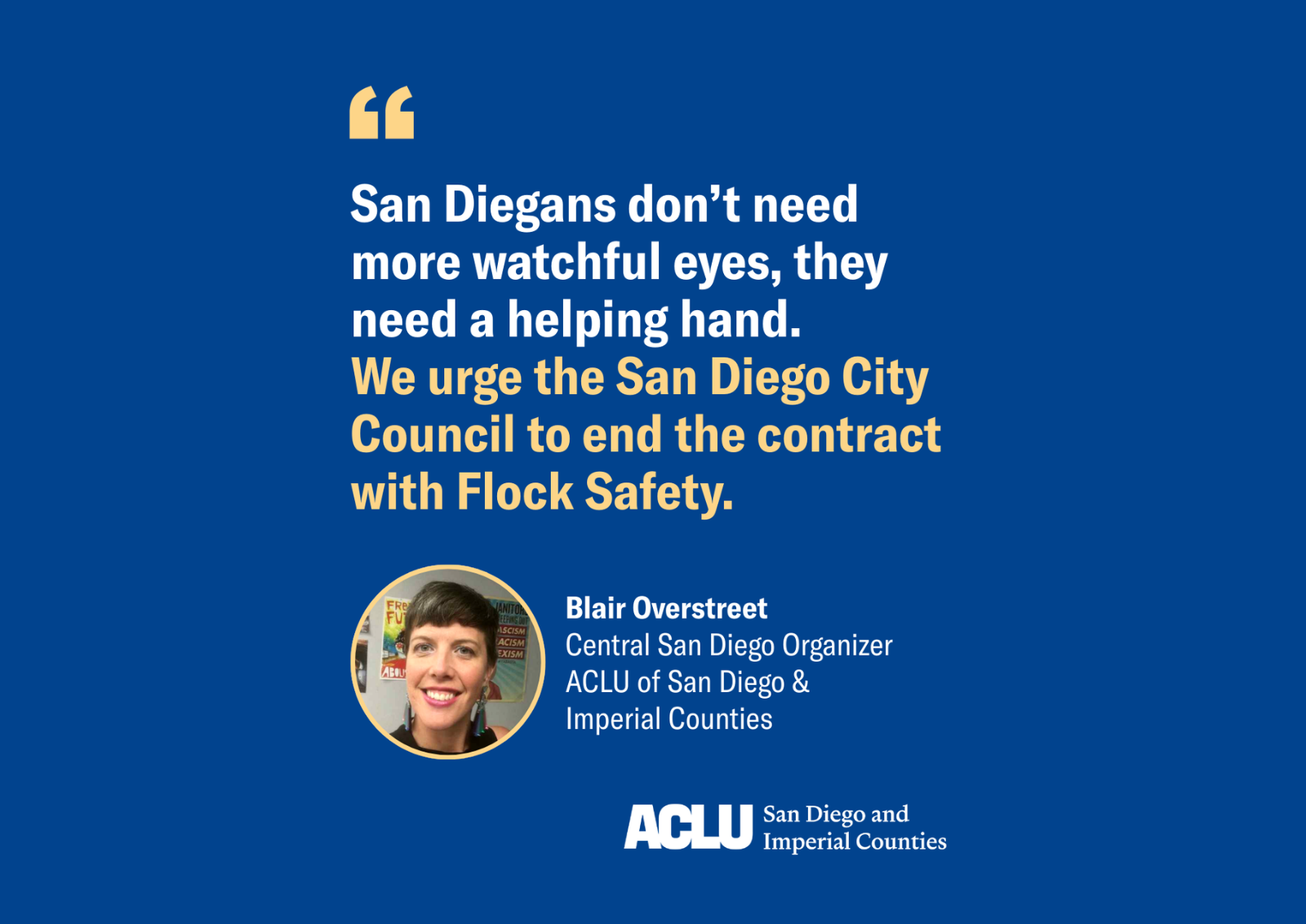
ACLU-SDIC Testimony – San Diego City Council Considers Whether to Continue Surveillance Use Policies
By Blair Overstreet
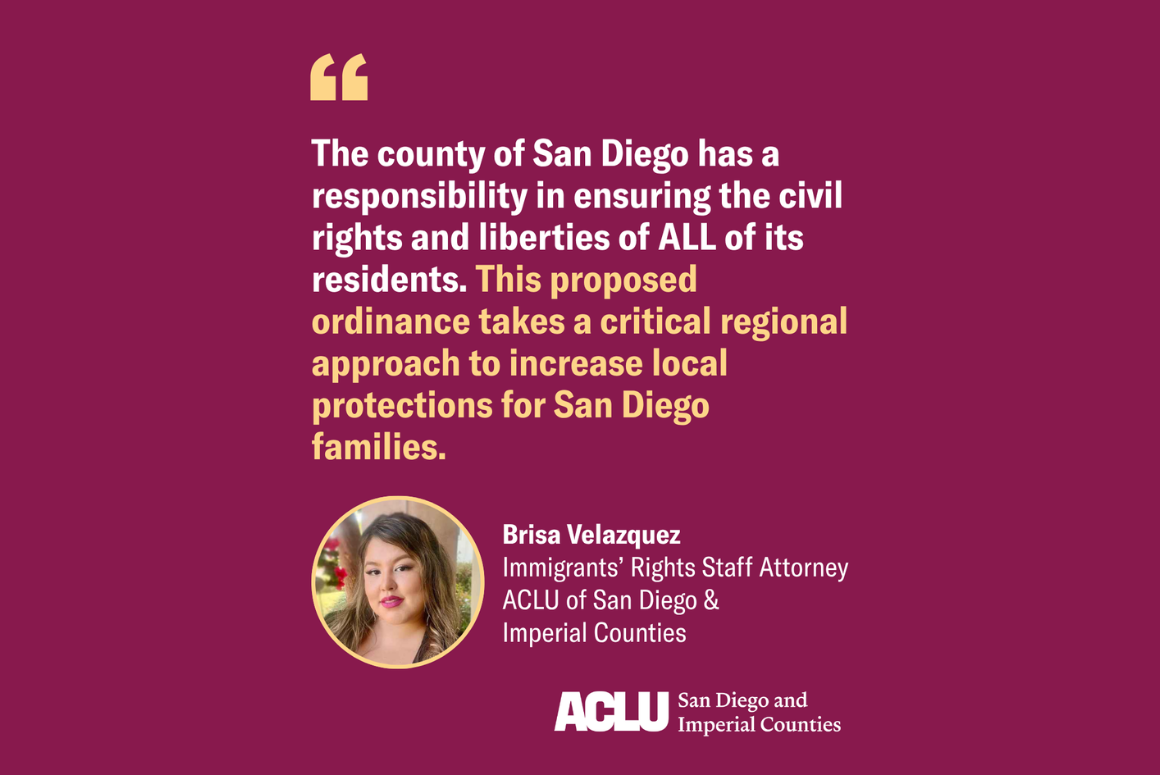
ACLU-SDIC Testimony – San Diego County Board of Supervisors Considers Drafting CLEAR Ordinance
By Brisa Velazquez
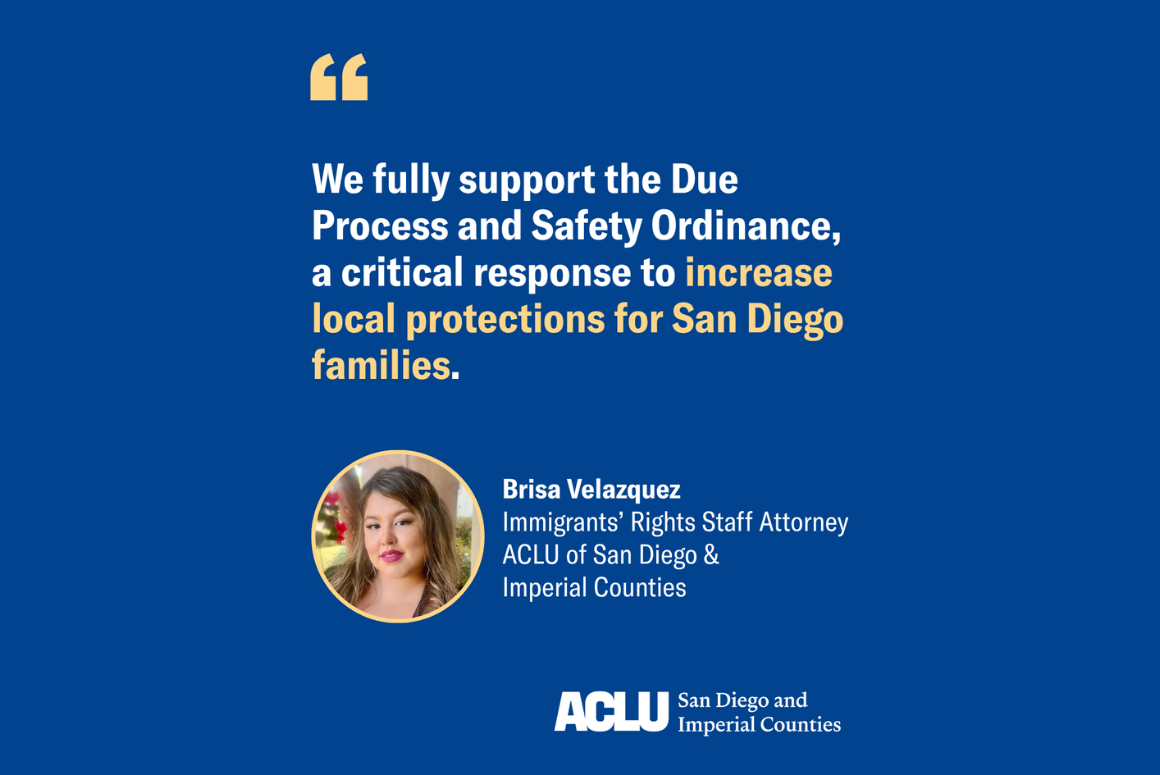
ACLU-SDIC Testimony – San Diego City Council Considers Due Process & Safety Ordinance
By Brisa Velazquez
San Diego ACLU Board Pays Tribute to Board Member James McElroy
The Board of the ACLU of San Diego & Imperial Counties recognizes esteemed board member Jim McElroy, for receiving one of the American Association for Justice’s top honors, the Leonard Weinglass in Defense of Civil Liberties Award this week. The Weinglass award is presented to the person “who has made a notable contribution to the defense of civil liberties by bringing, trying, or resolving a suit, or by otherwise protecting or advancing civil liberties, in a way that has had a significant impact in the past year or over the course of his/her career,” according to a statement by the AAJ, formerly known as the American Trial Lawyers Association.

ACLU and Civil Rights Coalition Weigh In on New Education Funding Formula
(Los Angeles)—A broad coalition of education and civil rights organizations, including the ACLU of California, are sending a letter today to all California county and district superintendents and charter school administrators urging immediate action to direct additional resources to the state’s neediest children.

San Diego ACLU Announces Departure of Admired Executive Director Kevin Keenan
# # #
2005 to 2013: Accomplishments Led or Co-Led by the ACLU of San Diego & Imperial Counties during Keenan’s Tenure
Successfully challenged the City of Escondido’s rental ban ordinance, which required landlords to screen the immigration status of prospective tenants, with the leadership of legal director David Loy in 2006, as well as led adoption of a state law in 2007 to prohibit any other California cities from passing such an ordinance;
Rapid response to mistreatment of immigrants and people of color during the 2007 wildfire recovery, including a report issued ten days after the fires, a state law to limit public employees’ screening for immigration status during a natural disaster, and a guidebook and training on the rights of immigrants during and after a natural disaster;
Successful challenge to inhumane overcrowding conditions and denial of medical care to immigration detainees at the San Diego Correctional Facility, run by the for-profit Corrections Corporation of America;
Challenged in court the government’s warrantless NSA spying and lobbied San Diego federal representatives against extension of the PATRIOT Act and FISA Amendments; conducted extensive public education about these and other abuses of power; unearthed domestic spying emanating from an intelligence “fusion center” at Camp Pendleton, including the use of informants to spy on the annual banquet of the Council on American Islamic Relations;
Published a 75-page report with Mexico’s National Commission of Human Rights on the humanitarian crisis of migrant deaths along the U.S.-Mexico border, finding that more than 5,000 people have died because of the deadly practices and policies of both governments;
Challenged rampant Border Patrol abuse of power and urged for reform of lethal force policies, especially the fatal shooting of rock throwers;
Under the direction of now associate director Norma Chavez Peterson, led a “get out the vote” campaign to mobilize Escondido's Latino vote in the 2012 Election and then establishing a long-term ACLU satellite office in Escondido staffed by a full-time community organizer to continue to respond to residents’ enduring civil liberties violations;
Helped mobilize a powerful, broad community response against Arizona’s racial profiling law, SB 1070; seconded a San Diego staff member to Arizona to assist its ACLU affiliate develop litigation challenging the law; and helped organize a strong community response to the Supreme Court’s decision overturning three parts of the law but upholding the “show me your papers” provision;
In conjunction with fellow border affiliates, and the generous support of the Price Family Charitable Fund and Central America and Mexico Migration Alliance, launched the Border Litigation Project staffed by two new attorneys in San Diego and Tucson, charged with pursuing legal strategies to combat persistent human right abuses at the U.S.- Mexico border;
Won a historic ruling in a class-action lawsuit in which the federal government is now required to provide legal counsel to mentally ill immigrant detainees;
Led the effort to secure passage of SB 35, dramatically increasing opportunities for voter registration in t

ACLU Border Affiliates Oppose Border Enforcement Provisions in S.744 Immigration Reform Bill
The ACLU Southwest Border affiliates, including the ACLU of California, issued the following joint statement in response to the Senate’s vote to proceed on immigration reform:



ACLU Expands Capacity to Challenge Abuses at the Border
SAN DIEGO and PHOENIX – In order to make America’s border agencies more accountable to the laws that protect us all, the American Civil Liberties Union (ACLU) today announced the launch of a new Border Litigation Project to investigate, document and litigate civil and human rights cases along the U.S.-Mexico border. The new initiative will allow the ACLU to increase its legal capacity along the Southwest border by hiring two new full-time staff attorneys in San Diego and Tucson.

Stay Informed
Sign up to be the first to hear about how to take action.
By completing this form, I agree to receive occasional emails per the terms of the ACLU’s privacy statement.
By completing this form, I agree to receive occasional emails per the terms of the ACLU’s privacy statement.